



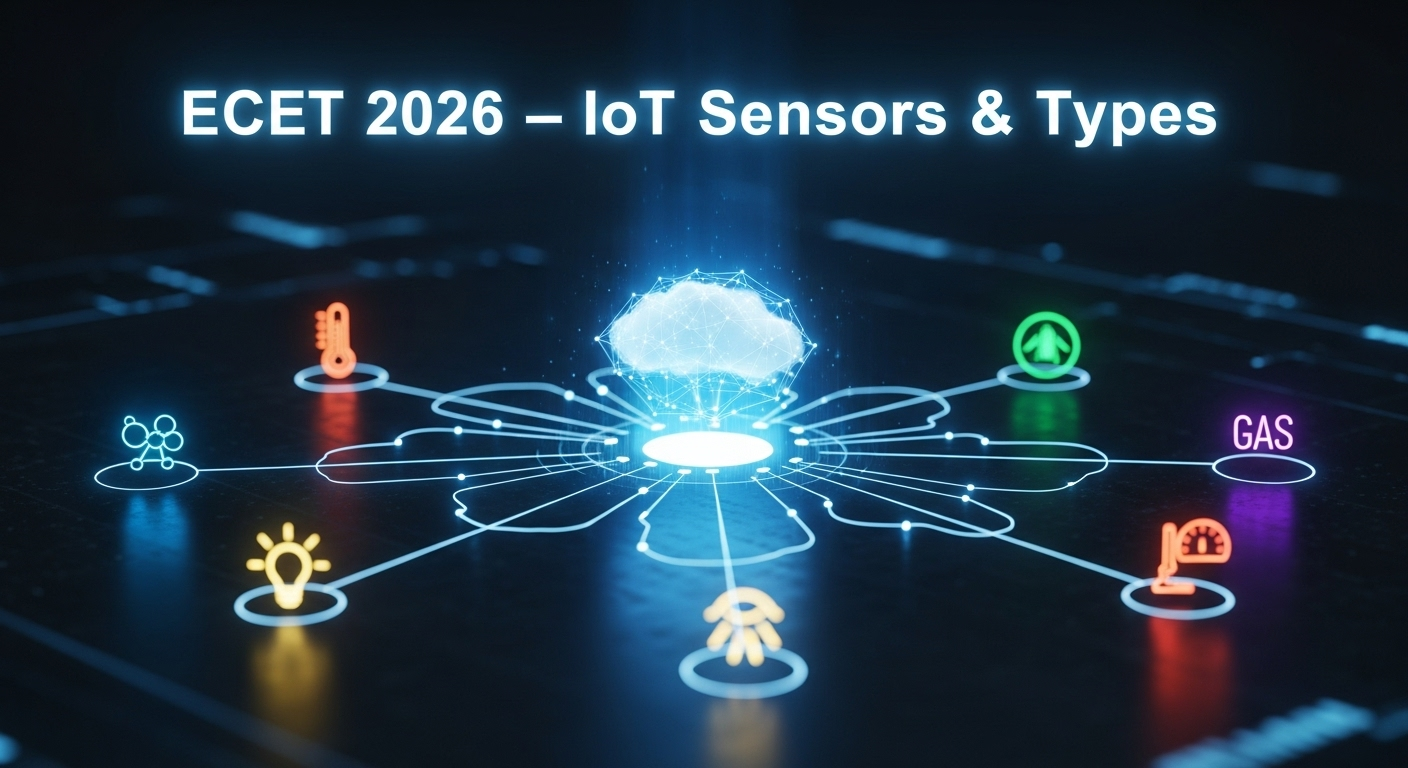
Concept Notes
1. Introduction to Sensors in IoT
- Sensor = a device that detects a physical quantity and converts it into an electrical signal.
- In IoT, sensors are the backbone → they sense real-world data and send it to microcontrollers/cloud.
- Examples: Temperature sensor in AC, Motion sensor in smart homes, Gas sensor in industries.
2. Sensor Working Principle
- Input: Physical parameter (temperature, light, pressure, etc.).
- Conversion: Physical → Electrical (via transduction).
- Output: Analog or Digital signal.
General Formula:
(where  = sensitivity).
3. Classification of Sensors
(A) Based on Power Requirement
- Active Sensors → Need external power supply.
- Ex: LIDAR, Ultrasonic, Radar.
- Passive Sensors → Do not require external power.
- Ex: Thermocouple, Photodiode.
(B) Based on Output
- Analog Sensors → Produce continuous output.
- Ex: LM35 temperature sensor.
- Digital Sensors → Produce discrete output (0/1).
- Ex: IR sensor, Proximity sensor.
(C) Based on Measured Quantity
- Temperature Sensors
- Ex: LM35, Thermistor, Thermocouple.
- Formula:
 (for LM35).
- Pressure Sensors
- Ex: Piezoelectric sensor, MEMS pressure sensor.
- Formula:

Light Sensors
- Ex: LDR (Light Dependent Resistor).
- Formula:

Proximity Sensors
- Detects presence/absence.
- Ex: IR sensor, Ultrasonic sensor.
Gas Sensors
- Ex: MQ2 (smoke), MQ7 (CO gas).
- Formula (sensitivity ratio):

Motion Sensors
- Ex: PIR sensor.
Humidity Sensors
- Ex: DHT11, DHT22.
- Formula:

4. IoT Applications of Sensors
- Smart Homes (motion, light, temperature).
- Healthcare (heart rate, glucose, BP sensors).
- Industry 4.0 (gas, vibration, pressure sensors).
- Agriculture (soil moisture, humidity, pH).
- Transportation (parking sensors, smart traffic).
⚙️ Formulas
Sensitivity:

Temperature (LM35):

Pressure:
Humidity (Relative):

LDR Resistance:
Gas Sensor Sensitivity:
🔟 10 MCQs
Q1. Which of the following is a passive sensor?
a) Thermocouple
b) Ultrasonic sensor
c) Radar
d) LIDAR
Q2. LM35 is used to measure:
a) Humidity
b) Temperature
c) Light intensity
d) Pressure
Q3. In an LDR, resistance is:
a) Proportional to light intensity
b) Inversely proportional to light intensity
c) Independent of light
d) None
Q4. PIR sensor detects:
a) Pressure
b) Motion
c) Gas
d) Sound
Q5. MQ2 sensor is used for:
a) CO gas
b) LPG/Smoke
c) Temperature
d) Humidity
Q6. Output of LM35 at 30°C is:
a) 0.3 V
b) 3 V
c) 0.03 V
d) 1 V
Q7. Which sensor is used in soil monitoring?
a) MQ7
b) LDR
c) Moisture sensor
d) PIR
Q8. DHT11 measures:
a) Only humidity
b) Only temperature
c) Temperature & Humidity
d) Gas levels
Q9. Which of the following is an active sensor?
a) Thermistor
b) Photodiode
c) Ultrasonic sensor
d) Thermocouple
Q10. The sensitivity of a sensor is defined as:
a) Output/Input
b) ΔOutput / ΔInput
c) Input/Output
d) Constant
✅ Answer Key
| Q No | Answer |
|---|---|
| Q1 | a |
| Q2 | b |
| Q3 | b |
| Q4 | b |
| Q5 | b |
| Q6 | a |
| Q7 | c |
| Q8 | c |
| Q9 | c |
| Q10 | b |
🧠 Explanations
- Q1: Thermocouple generates voltage from heat → passive.
- Q2: LM35 = temperature sensor.
- Q3: LDR →
 .
. - Q4: PIR detects human motion via infrared.
- Q5: MQ2 → smoke/LPG.
- Q6:
 .
. - Q7: Moisture sensor for soil.
- Q8: DHT11 = humidity + temperature.
- Q9: Ultrasonic uses external power → active.
- Q10: Sensitivity = ΔOutput/ΔInput.
🎯 Motivation
👉 IoT is the future of Electronics. Sensors are everywhere – from your phone’s accelerometer to cars’ parking sensors.
Mastering sensors + applications helps in both ECET exam & real-life projects.
“Every great IoT system begins with a small sensor.” 🌟
📲 CTA
🚀 Practice daily ECET quizzes on our ECET Portal to stay exam-ready!
👉 Visit Now

