



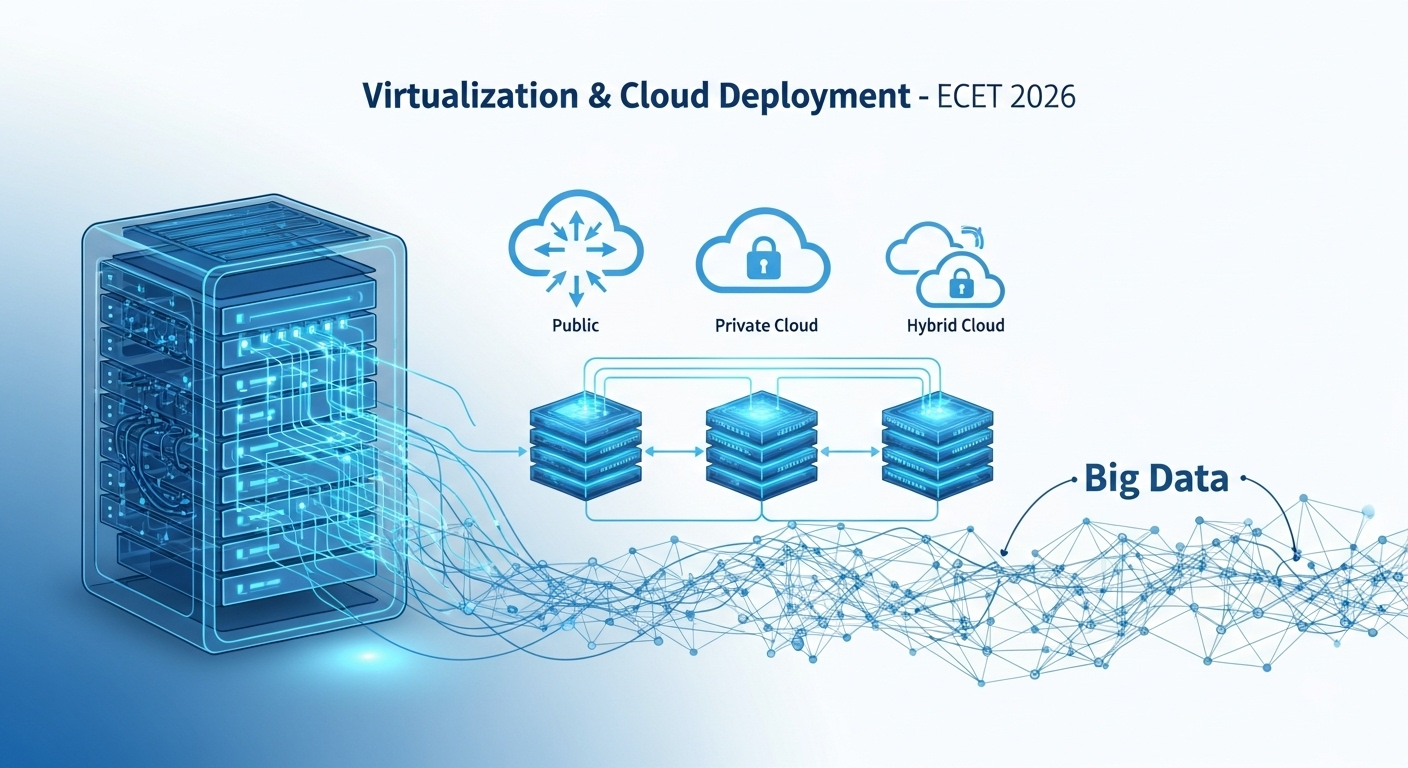
Big Data systems need high scalability, flexibility, and resource optimization. Two important technologies that make this possible are Virtualization and Cloud Deployment. ECET 2026 often includes questions from these topics — understanding the concepts clearly helps in both theory and MCQs.
📘 Concept Notes
☁️ Virtualization
Definition:
Virtualization is the process of creating a virtual version of a physical resource such as servers, storage, or networks.
Example:
A single physical server running multiple virtual machines (VMs) — each with its own OS — to maximize utilization.
Types of Virtualization:
- Server Virtualization: Divides one physical server into multiple virtual servers.
- Storage Virtualization: Combines multiple storage devices into a single virtual storage pool.
- Network Virtualization: Abstracts network resources for flexible traffic management.
- Desktop Virtualization: Allows users to access desktops remotely via virtual machines.
⚙️ Components of Virtualization
- Host Machine: The physical system that provides resources.
- Guest Machine: The virtual machine running on the host.
- Hypervisor: Software layer managing the VMs.
Two types of Hypervisors:
- Type 1 (Bare Metal): Runs directly on hardware (e.g., VMware ESXi, Xen).
- Type 2 (Hosted): Runs on a host operating system (e.g., VirtualBox, VMware Workstation).
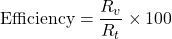
🔋 Formula – Virtualization Efficiency
If:
 = Total physical resources available
 = Resources utilized by all VMs
Then:

Example:
If total CPU capacity =  and VMs use
  , then:

☁️ Cloud Deployment
Definition:
Cloud deployment refers to how cloud resources (like servers, storage, or applications) are made available to users.
Deployment Models:
- Public Cloud: Services provided over the internet to multiple clients (e.g., AWS, Azure).
- Private Cloud: Cloud infrastructure operated for a single organization.
- Hybrid Cloud: Combination of public and private clouds.
- Community Cloud: Shared between organizations with common concerns.
📦 Cloud Service Models
- IaaS (Infrastructure as a Service): Provides virtualized hardware resources.
- Example: AWS EC2, Google Compute Engine.
- PaaS (Platform as a Service): Provides environment for developing and deploying apps.
- Example: Google App Engine, Heroku.
- SaaS (Software as a Service): Provides software via the internet.
- Example: Google Drive, Gmail, Salesforce.
📐 Example Scenario
A company wants to analyze 10 TB of Big Data without investing in physical servers.
- They use AWS EC2 (IaaS) to create virtual servers.
- Use Hadoop cluster deployed on the cloud.
- Data processed efficiently with minimum cost.
This shows how Virtualization + Cloud Deployment work together for Big Data analytics.
🔟 10 Most Expected MCQs – ECET 2026
Q1. Virtualization helps in:
A) Increasing hardware costs
B) Reducing resource utilization
C) Efficient resource sharing
D) Limiting scalability
Q2. The software that manages virtual machines is called:
A) Kernel
B) Hypervisor
C) Compiler
D) Driver
Q3. Which of the following is a Type 1 hypervisor?
A) VMware Workstation
B) VirtualBox
C) Xen
D) Parallels
Q4. In cloud computing, IaaS provides:
A) Software applications
B) Development platforms
C) Virtual hardware resources
D) Security features only
Q5. Which of the following is an example of SaaS?
A) AWS EC2
B) Google Drive
C) Heroku
D) VMware
Q6. A hybrid cloud is a combination of:
A) Public + Private
B) Public + Community
C) Private + Local
D) Local + Community
Q7. Virtualization efficiency is calculated using:
A) 
B) 
C) 
D) 
Q8. In virtualization, the machine running inside another system is called:
A) Host
B) Guest
C) Kernel
D) Node
Q9. The main advantage of virtualization is:
A) Higher hardware dependency
B) Fault tolerance and flexibility
C) Reduced performance
D) High cost
Q10. Which cloud model is best for government departments sharing infrastructure?
A) Public Cloud
B) Private Cloud
C) Hybrid Cloud
D) Community Cloud
✅ Answer Key
| Q.No | Answer |
|---|---|
| Q1 | C |
| Q2 | B |
| Q3 | C |
| Q4 | C |
| Q5 | B |
| Q6 | A |
| Q7 | B |
| Q8 | B |
| Q9 | B |
| Q10 | D |
🧠 Explanations
- Q1 → C: Virtualization allows efficient resource sharing.
- Q2 → B: Hypervisor manages virtual machines.
- Q3 → C: Xen runs directly on hardware (Type 1).
- Q4 → C: IaaS provides virtualized hardware.
- Q5 → B: Google Drive is a SaaS application.
- Q6 → A: Hybrid = Public + Private cloud.
- Q7 → B: Formula →
 .
. - Q8 → B: Guest machine is the VM.
- Q9 → B: Virtualization gives fault tolerance and flexibility.
- Q10 → D: Community Cloud is shared by organizations like government departments.
🎯 Why Practice Matters
- Virtualization and Cloud Deployment are trending Big Data infrastructure topics.
- ECET often includes concept-based and formula-based questions from this chapter.
- These concepts are also valuable in job interviews for cloud and data engineering roles.