



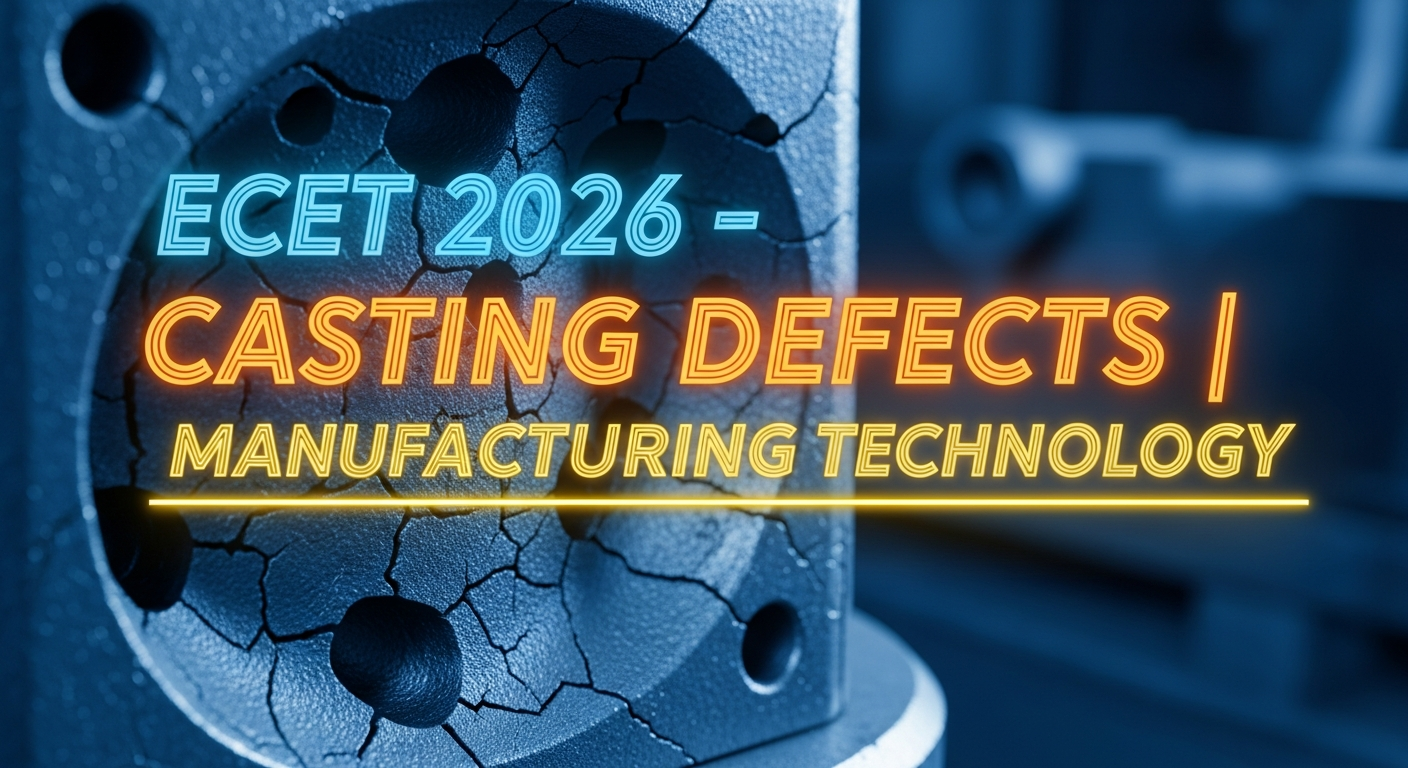
Casting Defects (Manufacturing Technology)
Why This Topic is Important for ECET 2026
Casting is one of the most common manufacturing processes in industries. In ECET Mechanical, 3–5 marks almost every year come from casting, especially defects, causes, and remedies because they test a student’s understanding of quality, manufacturing faults, and practical knowledge.
If you master casting defects, you can answer both theory + numerical questions easily.
📘 Concept Notes – Casting Defects (Easy + Deep Explanation)
Casting defects are unwanted irregularities that occur in a casting during the manufacturing process. These defects can occur due to wrong design, poor mold preparation, incorrect molten metal handling, or improper cooling.
We classify defects into groups for easy learning.
🔹 1. Defects Related to Gases
a) Blowholes
- Small spherical cavities.
- Caused due to entrapped gases (moisture, low permeability).
Example: Seen on the upper surface of castings.
b) Pinholes
- Very small gas holes just below the surface.
- Due to dissolved hydrogen in molten metal.
🔹 2. Defects Due to Shrinkage
a) Shrinkage Cavity
- Depression or void due to improper feeding as metal solidifies.
Example: Appears near thick sections where cooling is slow.
b) Riser Not Properly Designed
- Metal shrinks but riser cannot supply enough molten metal → cavities form.
🔹 3. Defects Due to Mold Issues
a) Sand Inclusion / Sand Hole
- Loose sand gets trapped inside the casting.
Cause: Weak sand or improper mold ramming.
b) Drop / Drop-In
- A portion of the mold breaks and falls into molten metal.
c) Cuts and Washes
- Metal erodes sand surface and washes it away.
🔹 4. Defects Due to Pouring Metal
a) Cold Shut
- Two streams of metal meet but do not fuse properly.
Reason: Low pouring temperature or slow pouring.
Appearance: A line/crease on casting.
b) Misrun
- Metal solidifies before filling the mold.
Reason: Extremely low fluidity.
🔹 5. Dimensional Defects
a) Warpage
- Distortion due to uneven cooling.
b) Mold Shift / Core Shift
- Misalignment of mold halves or core.
🔹 6. Metallurgical Defects
a) Hot Tear (Hot Cracking)
- Occurs during solidification under tensile stresses.
b) Segregation
- Alloy elements concentrate in certain regions.
🔹 How to Reduce Defects?
- Proper gating + riser design
- Controlled pouring temperature
- Moisture-controlled molding sand
- Adequate venting
- Proper ramming
- Good quality charge material
⚙️ Formulas (QuickLaTeX Format Only)
1. Shrinkage Allowance Formula

2. Modulus of Casting (Chvorinov’s Rule)

3. Solidification Time

4. Pouring Time (for a given gating)

5. Heat Required to Melt Metal

🔟 10 MCQs (Concept + Numerical + ECET Level)
Q1. Blowholes in castings are mainly caused by:
a) Low temperature
b) Trapped gases
c) Excess riser height
d) High permeability
Q2. Cold shut occurs due to:
a) Turbulence
b) High pouring temperature
c) Low fluidity
d) High venting
Q3. Shrinkage cavity forms due to insufficient:
a) Drag
b) Cope
c) Riser feeding
d) Vent holes
Q4. Sand inclusion is caused by:
a) Excessive fluidity
b) Weak mold strength
c) Higher superheat
d) Thick riser
Q5. Hot tears occur due to:
a) High compressive stress
b) High tensile stress during solidification
c) High mold temperature
d) Solidification shrinkage
Q6. A casting has volume 600 cm³ and surface area 400 cm². Find modulus.
a) 1.2 cm
b) 1.5 cm
c) 2.0 cm
d) 3.0 cm
Q7. For the same material, the casting that solidifies fastest is the one with:
a) Highest modulus
b) Lowest modulus
c) Highest volume
d) Highest riser size
Q8. Misrun defect is due to:
a) High pouring rate
b) Low fluidity
c) Strong mold
d) Excess venting
Q9. If two castings have equal modulus, then solidification time is:
a) Higher for heavier
b) Same
c) Lower
d) Depends on riser size
Q10. Pinholes in casting occur mainly because of:
a) Hydrogen gas
b) Carbon monoxide
c) Argon gas
d) Sulphur contamination
✅ Answer Key (WordPress-Friendly Table)
| Q | A |
|---|---|
| 1 | b |
| 2 | c |
| 3 | c |
| 4 | b |
| 5 | b |
| 6 | a |
| 7 | b |
| 8 | b |
| 9 | b |
| 10 | a |
🧠 Explanations (Detailed + Student-Friendly)
Q1 → b: Blowholes = trapped gases. Low permeability and moisture cause gas pockets. Others irrelevant.
Q2 → c: Cold shut = metal streams fail to fuse → low fluidity.
Q3 → c: Shrinkage cavity forms when riser doesn’t supply molten metal during freezing.
Q4 → b: Sand inclusion occurs when mold is weak; sand breaks off.
Q5 → b: Hot tears occur due to tensile stresses during solidification.
Q6 → a:
Modulus M=VAM = \frac{V}{A}M=AV
Correct answer = 1.5 cm → a
Q7 → b: Low modulus = faster solidification.
Q8 → b: Misrun = metal freezes before filling → low fluidity.
Q9 → b: Chvorinov’s rule shows solidification time depends only on modulus → equal modulus → equal time.
Q10 → a: Pinholes occur due to dissolved hydrogen in molten metal.
🎯 Motivation – Why Practice Matters for ECET 2026
Casting defects appear in direct questions, match-the-following, and numerical problems.
If you practice regularly:
- You solve faster than others
- You avoid silly mistakes
- You gain confidence for 60–70% manufacturing questions
- You score full marks easily because this chapter is simple and repeated every year
👉 Mastering defects = Free scoring zone in ECET 2026.
📲 CTA
Join our WHATSAPP group for ECET 2026 updates and discussions →
👉 https://chat.whatsapp.com/GniYuv3CYVDKjPWEN086X9

