


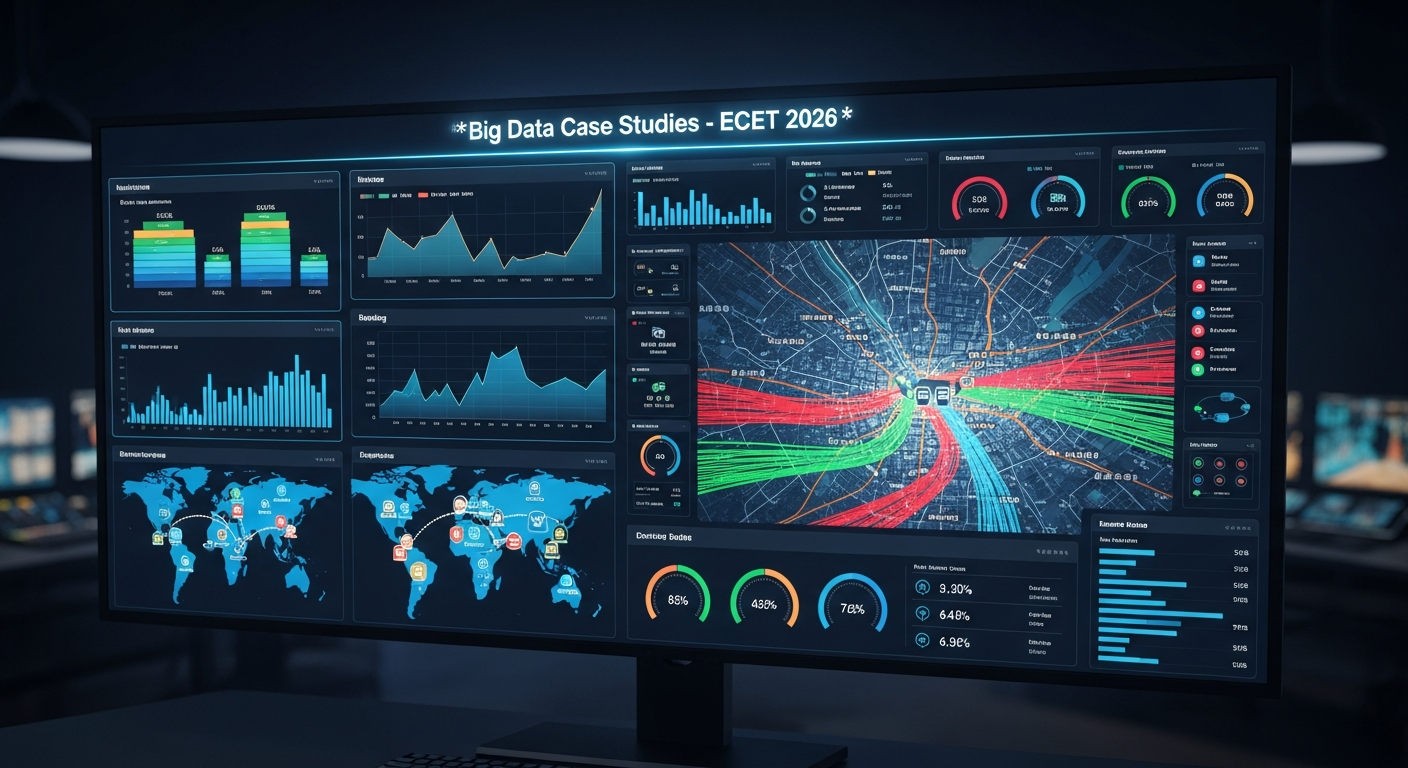
Big Data is used everywhere — from online shopping to banking, hospitals, traffic control, telecom, and social media.
Understanding real-time case studies helps ECET students relate theory to real-world applications.
This topic is mostly theory, but ECET asks conceptual MCQs, so this blog covers examples, definitions, and important points clearly.
📘 Concept Notes – Big Data Case Studies
🔥 What is Big Data?
Big Data refers to data that is Huge (Volume), Fast (Velocity), Varied (Variety) and cannot be processed with traditional systems.
The famous 5V model:
- Volume – Large amounts of data
- Velocity – Fast data generation
- Variety – Structured & unstructured
- Veracity – Accuracy of data
- Value – Useful insights from data
No formulas here except the model, but for WordPress formatting, giving it as:

💼 Real-Time Case Studies & Use Cases
Below are the most common real-life scenarios where Big Data technologies (Hadoop, Spark, Kafka, HBase, HDFS, etc.) are used.
1️⃣ E-Commerce (Amazon, Flipkart) – Recommendation Systems
How Big Data is used:
- Tracks user clicks, searches, purchases.
- Recommends products using Machine Learning.
- Uses tools like Spark, Hadoop, Kafka.
Example:
If a user searches for “headphones,” the system shows:
- Related products
- Frequently bought items
- Deals and offers
This improves sales and user experience.
2️⃣ Banking & Fraud Detection
Banks process millions of transactions every second. Big Data helps:
- Identify unusual spending
- Detect fraud in real-time
- Monitor credit card usage
Example:
If your card is used suddenly in another country, the system flags as suspicious.
3️⃣ Healthcare – Predictive Analytics
Hospitals use Big Data for:
- Predicting disease outbreaks
- Analyzing patient health records
- Monitoring ICU data in real-time
Example:
Big Data + AI can predict early signs of heart attack using:

4️⃣ Social Media (Facebook, Instagram, YouTube)
Social media produces petabytes of data every day.
Uses:
- Personalized ads
- Video recommendations
- Trend analysis
- Fake account detection
Example:
You watch a tech video → YouTube recommends tech-related content using ML models.
5️⃣ Smart Cities & Traffic Management
Big Data helps control:
- Traffic signals
- City cameras
- Pollution sensors
Example:
Sensors send live data → Big Data system decides signal timing.
6️⃣ Telecom Industry (Airtel, Jio)
Uses:
- Predict network load
- Optimize tower placement
- Detect call failures
Formula-like representation:

7️⃣ Retail & Supermarkets (Walmart Case Study)
Big Data used for:
- Inventory management
- Demand prediction
- Pricing strategy
Example:
Before a storm, Walmart noticed increased sales of:
- torches
- batteries
- snacks
Stores stock these items in advance using data analytics.
8️⃣ Ride-Sharing Apps (Uber, Ola)
Uses:
- Dynamic pricing
- Trip suggestions
- Shortest routes
- Driver-passenger matching
Example Dynamic Pricing:

🔟 10 Expected MCQs – ECET 2026
Q1. Big Data mainly deals with:
A) Large and complex datasets
B) Small datasets
C) Only structured data
D) Only cloud data
Q2. Recommendation systems use:
A) Big Data + Machine Learning
B) Only SQL
C) HTML
D) BIOS
Q3. Fraud detection in banking is a:
A) Batch process
B) Real-time analytics use case
C) Offline process
D) None
Q4. Smart city traffic control uses data from:
A) CCTV sensors
B) Pollution sensors
C) GPS devices
D) All of the above
Q5. Healthcare prediction models use:
A) Historical patient data
B) Random guessing
C) Only physical tests
D) None
Q6. Social media platforms generate:
A) Very small data
B) No unstructured data
C) Huge amounts of unstructured data
D) Only text data
Q7. Big Data in telecom helps in:
A) Network optimization
B) Wallpaper management
C) Tone selection
D) Only SMS promotion
Q8. Surge pricing in Uber is based on:
A) Low demand
B) Demand–supply analytics
C) Driver mood
D) Fuel price
Q9. Walmart used Big Data to:
A) Delete customer data
B) Predict product demand
C) Remove stores
D) Change brand name
Q10. Big Data real-time systems typically use:
A) Hadoop + Spark + Kafka
B) MS Paint
C) PowerPoint
D) BIOS
✅ Answer Key
| Q.No | Answer |
|---|---|
| Q1 | A |
| Q2 | A |
| Q3 | B |
| Q4 | D |
| Q5 | A |
| Q6 | C |
| Q7 | A |
| Q8 | B |
| Q9 | B |
| Q10 | A |
🧠 Explanations
- Q1 → A: Big Data = huge + complex datasets.
- Q2 → A: Recommendation uses ML + Big Data.
- Q3 → B: Fraud detection must be real-time.
- Q4 → D: All sensors provide traffic data.
- Q5 → A: Predictions use historical data.
- Q6 → C: Social media = unstructured big data.
- Q7 → A: Telecom uses Big Data for network optimization.
- Q8 → B: Surge price = demand-supply.
- Q9 → B: Walmart predicted demand using analytics.
- Q10 → A: Real-time systems use Hadoop ecosystem.
🎯 Why Practice Matters
Real-time case studies help ECET students understand:
- Why companies use Big Data
- Where analytics is applied
- What systems use real-time processing
- How theoretical concepts become real solutions
Mastering these examples makes exam answers easier and industry-ready.
📲 Join Our ECET Prep WhatsApp Community
👉 Join WhatsApp Group:
https://chat.whatsapp.com/GniYuv3CYVDKjPWEN086X9
For daily ECET notes, MCQs, quizzes, and PDFs.