



Concept Notes (Deep Explanation + Examples)
🔹 Introduction
A Gas Turbine is a rotary type internal combustion engine where the working fluid is a gas (usually air).
It converts chemical energy of fuel into mechanical energy through a continuous combustion process — unlike IC engines which work on intermittent combustion.
Gas turbines are widely used in aircraft engines, power plants, naval ships, and industrial drives.
🔹 Basic Working Principle
The gas turbine operates on the Brayton Cycle, also called the Joule Cycle.
The main processes are:
1️⃣ Isentropic Compression (in the compressor)
- Air is compressed by a rotary compressor.
- Pressure and temperature rise.
2️⃣ Constant Pressure Heat Addition (in the combustion chamber)
- Compressed air mixes with fuel and burns at constant pressure.
- The temperature of the gas rises sharply.
3️⃣ Isentropic Expansion (in the turbine)
- High-temperature gas expands through the turbine.
- Produces mechanical power output.
4️⃣ Constant Pressure Heat Rejection (to atmosphere)
🔹 Brayton Cycle Diagram Explanation
- On p–v and T–s diagrams, the cycle appears as two isentropic (vertical) and two constant pressure (horizontal) processes.
- The compressor consumes part of turbine power, and the net power output = turbine power − compressor power.
🔹 Components of a Gas Turbine System
1️⃣ Compressor:
- Draws air and compresses it (pressure ratio: 4:1 to 10:1 for small plants, up to 30:1 in modern units).
- Can be axial or centrifugal type.
2️⃣ Combustion Chamber:
- Adds heat by burning fuel with compressed air.
- Operates at nearly constant pressure.
3️⃣ Turbine:
- Expands hot gases to produce shaft work.
- Drives both compressor and external load.
4️⃣ Auxiliary Systems:
- Starting system, lubrication, and cooling systems.
🔹 Open vs Closed Cycle Gas Turbines
| Type | Working Medium | Heat Transfer | Efficiency | Application |
|---|---|---|---|---|
| Open Cycle | Air-fuel mixture expelled to atmosphere | Direct combustion | Lower | Aircraft, power generation |
| Closed Cycle | Working fluid recirculated (e.g., helium, air) | External heater | Higher | Industrial continuous operation |
🔹 Improvements in Gas Turbine Efficiency
To increase efficiency and output power, the following methods are used:
1️⃣ Intercooling → reduces compressor work
2️⃣ Reheating → increases turbine work
3️⃣ Regeneration → recovers heat from exhaust gases
🔹 Advantages
✅ High power-to-weight ratio
✅ Smooth operation (rotary type)
✅ Low maintenance
✅ Can start quickly
✅ Suitable for aircraft and marine applications
🔹 Disadvantages
❌ Low thermal efficiency at part loads
❌ Requires high-quality materials (for high-temperature operation)
❌ High initial cost
🔹 Real-World Example
In a jet engine, a gas turbine works as:
- Air enters → compressed → mixed with fuel → burnt → expands through turbine → thrust produced by exhaust jet.
In a gas turbine power plant, turbine drives both compressor and electric generator.
🔹 ECET-Level Important Concept
Thermal efficiency for ideal Brayton cycle is:
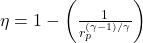
where = pressure ratio
 = specific heat ratio
⚙️ Formulas (Plain LaTeX, NO boxes)



🔟 10 MCQs (GATE + ECET Mix)
1️⃣ In a gas turbine, the working cycle is:
A) Otto cycle
B) Brayton cycle
C) Diesel cycle
D) Rankine cycle
2️⃣ The main advantage of a gas turbine over IC engines is:
A) Lower speed
B) Low initial cost
C) Continuous combustion
D) High fuel consumption
3️⃣ The compressor in a gas turbine consumes:
A) Negligible power
B) 10% of turbine power
C) 50–60% of turbine power
D) None
4️⃣ Regeneration in a gas turbine is used to:
A) Increase turbine work
B) Reduce turbine work
C) Increase efficiency
D) Reduce efficiency
5️⃣ Which component adds heat at constant pressure?
A) Compressor
B) Combustion chamber
C) Turbine
D) Diffuser
6️⃣ For a Brayton cycle with  and
and  , find efficiency.
A) 26.4%
B) 30%
C) 45%
D) 56%
7️⃣ The gas turbine efficiency increases with:
A) Decrease in pressure ratio
B) Increase in pressure ratio
C) Decrease in turbine inlet temperature
D) Decrease in compressor efficiency
8️⃣ The cycle used in a jet engine is:
A) Otto cycle
B) Brayton cycle
C) Dual cycle
D) Rankine cycle
9️⃣ The specific output of a gas turbine can be increased by:
A) Reheating
B) Regeneration
C) Intercooling
D) None
10️⃣ In a gas turbine, air is compressed:
A) Isothermally
B) Isentropically
C) Isochorically
D) Polytropically
✅ Answer Key (WordPress Table Format)
Q.No Answer
1 B
2 C
3 C
4 C
5 B
6 A
7 B
8 B
9 A
10 B
🧠 MCQ Explanations
1️⃣ B — Brayton cycle
Gas turbines operate on the Brayton (Joule) cycle involving constant-pressure heat addition.
2️⃣ C — Continuous combustion
Unlike reciprocating engines, gas turbines burn fuel continuously for smooth power.
3️⃣ C — 50–60% of turbine power
Compressor consumes a large portion of turbine output power.
4️⃣ C — Increase efficiency
Regeneration recovers exhaust heat to preheat air → saves fuel → higher efficiency.
5️⃣ B — Combustion chamber
Heat addition happens at constant pressure inside the combustion chamber.
6️⃣ A — 26.4%

7️⃣ B — Increase in pressure ratio
As pressure ratio increases, cycle efficiency improves up to an optimal point.
8️⃣ B — Brayton cycle
Jet engines are practical forms of open-cycle Brayton engines.
9️⃣ A — Reheating
Reheating increases turbine work and thus specific output.
10️⃣ B — Isentropically
Compression is assumed isentropic in ideal Brayton cycle analysis.
🎯 Motivation (ECET 2026 Specific)
Gas Turbines are repeatedly asked in ECET because they combine thermodynamics, cycle analysis, and real-world applications like jet engines and power plants.
By mastering this topic, you’ll confidently answer multiple questions in Thermal Engineering and Applied Thermodynamics sections.
Keep practicing — consistency converts effort into rank improvement!
📲 CTA (Always Fixed)
Join our ECET 2026 Mechanical WhatsApp Group for daily quizzes & study notes:
👉 https://chat.whatsapp.com/GniYuv3CYVDKjPWEN086X9

