



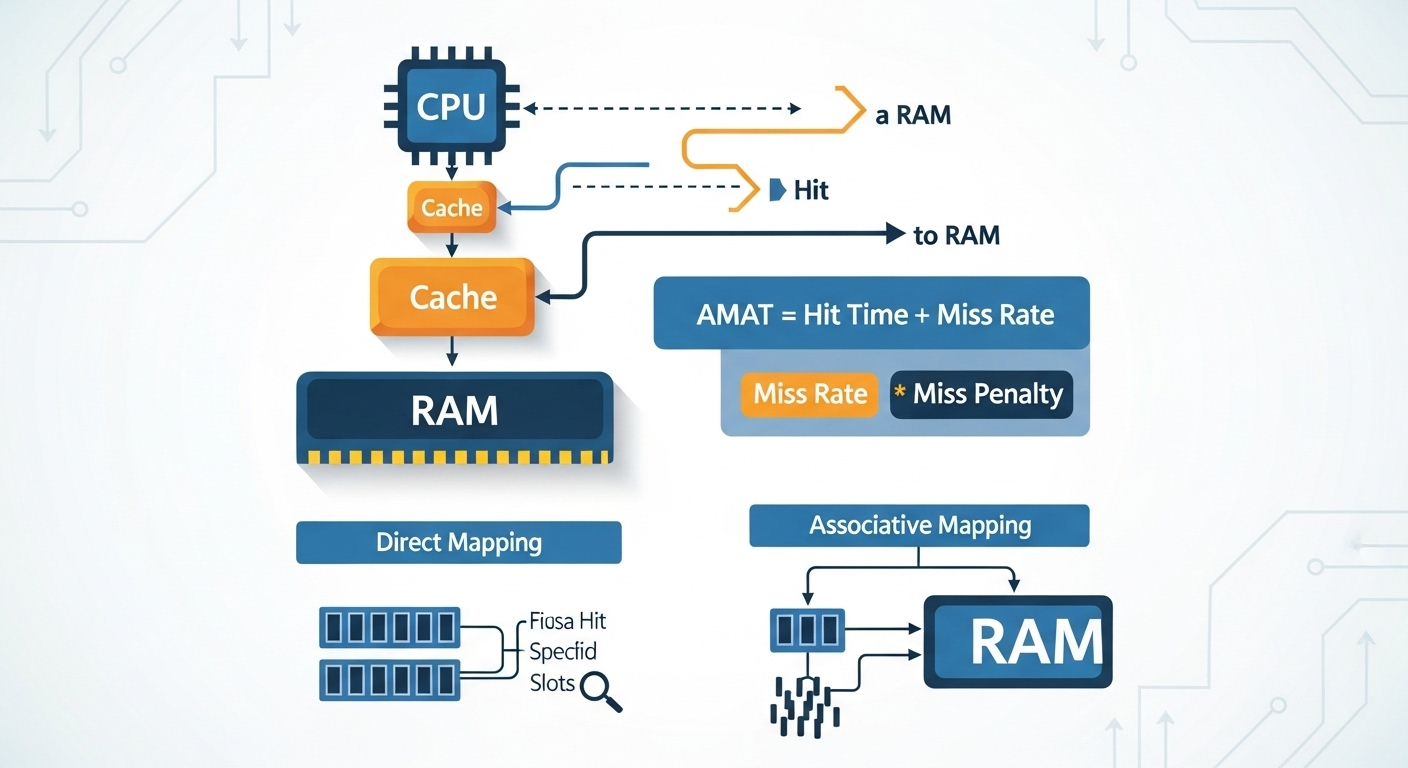
In Computer Organization & Architecture (COA), memory concepts are frequently tested in ECET. Topics like RAM, cache memory, and mapping techniques are high-scoring.
📘 Concept Notes
1️⃣ Types of Memory
- Primary Memory: RAM, Cache, Registers (fast, volatile).
- Secondary Memory: HDD, SSD (non-volatile, large).
🔹 RAM (Random Access Memory)
- Volatile memory, stores currently running programs/data.
- Types:
- SRAM: Static RAM (faster, costly, used in cache).
- DRAM: Dynamic RAM (slower, cheaper, used in main memory).
🔹 Cache Memory
- Small, high-speed memory between CPU & RAM.
- Stores frequently accessed instructions/data.
- Reduces Average Memory Access Time (AMAT):

- Hit Ratio (h):

- Miss Ratio:

🔹 Cache Mapping Techniques
- Direct Mapping:
- Each block of main memory maps to exactly one cache line.
- Formula:

Simple, but may cause conflicts.
Associative Mapping:
- Any block can be placed in any cache line.
- Expensive hardware, but flexible.
Set-Associative Mapping:
- Hybrid of direct & associative.
- Cache divided into sets, block maps to a set, but can go to any line within set.
📐 Example – Cache Hit/Miss
- Assume:
- Hit Ratio =

- Hit Time =

- Miss Penalty =

- Hit Ratio =

🔟 10 Expected MCQs – ECET 2026
Q1. RAM is a type of:
A) Secondary memory
B) Volatile memory
C) Non-volatile memory
D) Optical memory
Q2. SRAM is mainly used in:
A) Hard Disk
B) Cache Memory
C) Registers
D) Flash Drives
Q3. Formula for Average Memory Access Time (AMAT) is:
A) 
B) 
C) 
D) None
Q4. If cache hit ratio = 0.95, hit time = 5 ns, miss penalty = 50 ns → AMAT = ?
A) 7.25 ns
B) 10 ns
C) 50 ns
D) 5 ns
Q5. In direct mapping, cache line number = ?
A) Block Number + Cache Size
B) Block Number – Cache Lines
C) Block Number mod Cache Lines
D) None
Q6. Which cache mapping technique is most flexible but costly?
A) Direct Mapping
B) Associative Mapping
C) Set Associative
D) Random
Q7. Which memory is fastest?
A) RAM
B) Cache
C) Registers
D) SSD
Q8. Miss Ratio is calculated as:
A) 
B) 
C) Both A & B
D) None
Q9. DRAM stands for:
A) Dynamic Read Access Memory
B) Dynamic Random Access Memory
C) Direct Random Access Memory
D) Data RAM
Q10. Which mapping technique is a compromise between direct and associative?
A) Direct
B) Set Associative
C) Associative
D) None
✅ Answer Key
| Q.No | Answer |
|---|---|
| Q1 | B |
| Q2 | B |
| Q3 | B |
| Q4 | A |
| Q5 | C |
| Q6 | B |
| Q7 | C |
| Q8 | C |
| Q9 | B |
| Q10 | B |
🧠 Explanations
- Q1 → B: RAM is volatile, loses data when power off.
- Q2 → B: SRAM used in cache.
- Q3 → B: Correct formula for AMAT.
- Q4 → A:
 .
. - Q5 → C: Direct mapping formula = block number mod cache lines.
- Q6 → B: Associative is flexible but costly.
- Q7 → C: Registers are fastest.
- Q8 → C: Both formulas valid.
- Q9 → B: DRAM = Dynamic Random Access Memory.
- Q10 → B: Set-associative is compromise.
🎯 Why Practice Matters
- Memory questions are guaranteed in COA section of ECET.
- Formulas like AMAT and direct mapping are direct questions.
- Cache concepts are also important in job interviews.