


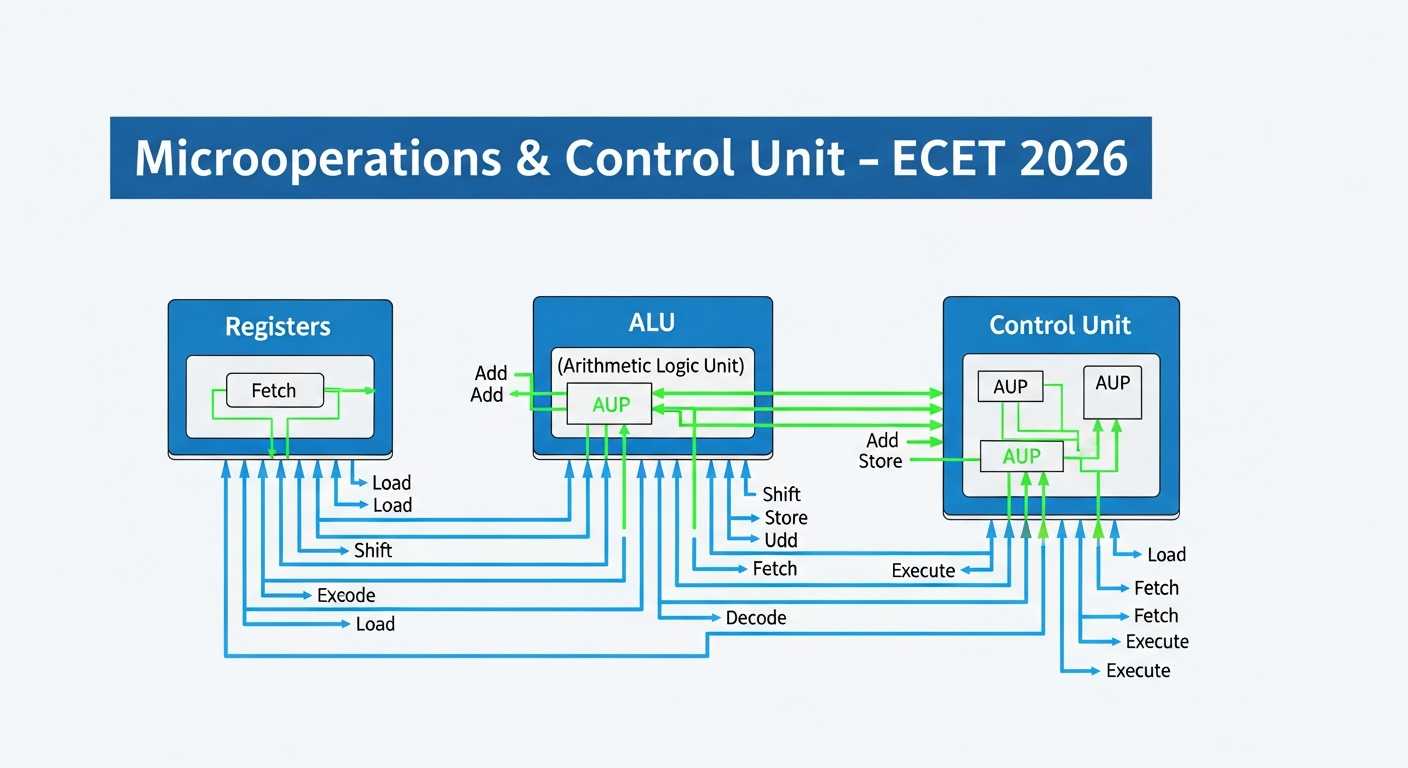
In ECET 2026 Computer Organization & Architecture (COA), Microoperations and Control Unit is a very important topic. It forms the foundation for understanding how instructions are executed at the hardware level. You can expect 2–3 direct MCQs from this topic.
📘 Concept Notes
⚙️ What are Microoperations?
- A microoperation is a simple, basic operation performed on the data stored in registers.
- Each instruction in a CPU is broken down into several microoperations that happen during one or more clock cycles.
Example:
If CPU executes the instruction A ← B + C,
the microoperations might be:
- Transfer data from register B and C to ALU
- Perform addition
- Store result in A
🧠 Types of Microoperations
- Register Transfer Microoperations
- Move data from one register to another.
- Example:

(Contents of transferred to
  ).
).
- Arithmetic Microoperations
- Perform arithmetic operations like addition, subtraction, increment, etc.
- Example:

- Common operations:

Logic Microoperations
- Perform bitwise logical operations.
- Example:

- Common logic ops: AND, OR, XOR, NOT.
Shift Microoperations
- Shifts the bits of a register.
- Example:
- Logical Left Shift:

- Logical Right Shift:

- Arithmetic Shift: Preserves sign bit in signed numbers.
- Circular Shift: Bits rotate around (last bit becomes first).
- Logical Left Shift:
🧮 Formula Examples
1. Arithmetic Operation Example:
If  (5) and
  (3), then

2. Shift Operation Example:
If  , then
- Left shift →

- Right shift →

🧩 Control Unit
The Control Unit (CU) is the part of the CPU that manages and coordinates all microoperations.
It tells the CPU what to do and when to do it by generating control signals.
Types of Control Units
- Hardwired Control Unit
- Uses fixed hardware logic (combinational circuits).
- Very fast but difficult to modify.
- Used in RISC processors.
- Microprogrammed Control Unit
- Uses microinstructions stored in control memory.
- Easier to modify and debug.
- Used in CISC processors.
⚡ Control Signals
The CU generates control signals to enable various microoperations.
For example, if we want to transfer data from register R2 to R1:
The CU sends a signal to enable R2 output and R1 input.
🔁 Instruction Cycle and Microoperations
Each instruction goes through 4 main phases, and each phase has microoperations:
| Phase | Description | Example Microoperations |
|---|---|---|
| Fetch | Get instruction from memory | ![IR \leftarrow M[PC]](https://learnnewthings.fun/wp-content/ql-cache/quicklatex.com-1e7de2d14492bcf60f370b2ade4f45c0_l3.png "Rendered by QuickLaTeX.com") , ,  |
| Decode | Interpret instruction |  |
| Execute | Perform operation |  |
| Store | Save result | ![M[Addr] \leftarrow R_1](https://learnnewthings.fun/wp-content/ql-cache/quicklatex.com-aeb9ba59fe814db00f1426e66a295667_l3.png "Rendered by QuickLaTeX.com") |
📘 Example – Control Unit Working
Let’s take an instruction: ADD R1, R2
- Fetch:
Decode:
CU decodes opcode (ADD).
Execute:
Store (if needed):
Result written back to memory or register.
🔟 10 Most Expected MCQs – ECET 2026
Q1. A microoperation is performed on:
A) Memory bits
B) Register data
C) Input devices
D) Control signals
Q2. Register transfer operation can be represented as:
A) 
B)
C) 
D) 
Q3. The control unit of a CPU:
A) Performs arithmetic operations
B) Stores data
C) Directs microoperations using control signals
D) Performs I/O functions
Q4. A 4-bit register can hold:
A) 4 bits
B) 8 bits
C) 16 bits
D) 32 bits
Q5. In arithmetic microoperation , which component performs addition?
A) Control Unit
B) ALU
C) Decoder
D) Register File
Q6. Logical operations include:
A) Add, Subtract
B) AND, OR, XOR, NOT
C) Shift, Rotate
D) Load, Store
Q7. Microprogrammed control unit uses:
A) Hardware logic
B) Control memory
C) Cache
D) Decoder only
Q8. Hardwired control is:
A) Slower but flexible
B) Faster but less flexible
C) Both slow and flexible
D) None
Q9. Circular shift means:
A) Bits lost from ends
B) Bits rotated around
C) Sign bit preserved
D) Bitwise AND operation
Q10. The fetch operation of an instruction is represented as:
A)
B)
C) 
D) 
✅ Answer Key
| Q.No | Answer |
|---|---|
| Q1 | B |
| Q2 | B |
| Q3 | C |
| Q4 | A |
| Q5 | B |
| Q6 | B |
| Q7 | B |
| Q8 | B |
| Q9 | B |
| Q10 | A |
🧠 Explanations
- Q1 → B: Microoperations act on registers.
- Q2 → B: Register transfer uses “←” symbol.
- Q3 → C: Control Unit generates signals for microoperations.
- Q4 → A: 4 flip-flops = 4 bits.
- Q5 → B: ALU performs arithmetic operations.
- Q6 → B: Logical ops = AND, OR, XOR, NOT.
- Q7 → B: Microprogrammed control uses control memory.
- Q8 → B: Hardwired = fast, less flexible.
- Q9 → B: Circular shift rotates bits.
- Q10 → A: Fetch phase loads instruction into IR.
🎯 Why Practice Matters
This topic is easy but conceptual — if you understand types of microoperations and control unit types, you can easily score marks in COA. It also helps in understanding how real processors work.