



CONCEPT NOTES (Deep Explanation + Examples)
🔹 Introduction
Network theorems are the heart of circuit analysis. They simplify complex circuits into easier equivalent forms — perfect for solving problems quickly in ECET.
In this part (Part 2), we focus on Thevenin’s Theorem, Norton’s Theorem, and Superposition Theorem — the 3 most frequently asked topics in ECET and GATE-level ECE questions.
🔹 1. Thevenin’s Theorem
Statement:
Any linear two-terminal circuit can be replaced by an equivalent voltage source (Vth) in series with a resistance (Rth).
Think of it like this:
A complex network behaves just like a single battery (Thevenin voltage) and a single resistor (Thevenin resistance).
Step-by-step method:
- Remove the load resistor RL.
- Find open-circuit voltage across the open terminals → this is
 .
. - Replace all independent voltage sources with short circuits and current sources with open circuits.
- Find the equivalent resistance between open terminals → this is
 .
. - The equivalent circuit = in series with , connected to
 .
.
Example:
Suppose we have a 12V source in series with a 4Ω resistor, connected to a 6Ω load resistor.
- Remove the 6Ω load → open circuit voltage across the terminals = 12V (since no drop).
 ,
,  .
.
Reconnecting load: .
.
Practical link:
In labs, you can test this using breadboards — measure voltage with load connected and compare it with Thevenin equivalent predictions. Results match exactly!
🔹 2. Norton’s Theorem
Statement:
Any linear two-terminal network can be replaced by an equivalent current source (In) in parallel with a resistance (Rn).
Relationship with Thevenin:

Steps:
- Remove load.
- Find short-circuit current → this is
 .
. - Find equivalent resistance between open terminals (as before) →
 .
. - The equivalent network is a current source in parallel with .
Example:
From earlier example: , .
So 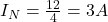 ,
,  .
.
With load 6Ω, .
.
Observation:
Same current as Thevenin’s theorem → proves both are equivalent.
🔹 3. Superposition Theorem
Statement:
In any linear circuit with multiple independent sources, the total current or voltage in any branch is the algebraic sum of currents/voltages produced by each source acting alone (all others replaced by their internal resistances).
Steps:
- Consider one source at a time — deactivate all others:
- Replace voltage sources with short circuits.
- Replace current sources with open circuits.
- Find contribution of that source.
- Repeat for all sources.
- Add algebraically all contributions.
Example:
For a circuit with two voltage sources (10V, 5V) connected through resistors:
Find current due to 10V alone, then 5V alone, then add both currents.
Practical logic:
Used in communication circuits where multiple signals act together — like mixed analog voltages in an amplifier.
🔹 Visual Description (in words)
Imagine:
- For Thevenin — a battery and resistor in series.
- For Norton — a current source with resistor in parallel.
- For Superposition — multiple batteries feeding one network, analyzed one at a time.
🔹 ECET Importance
Nearly every ECET ECE circuit paper has at least 2 marks from Thevenin/Norton/Superposition.
They test your speed and conceptual clarity.
3️⃣ ⚙️ FORMULAS




4️⃣ 🔟 10 MCQs (GATE + ECET Mix)
- Thevenin’s theorem is applicable only to:
A) Non-linear circuits
B) Linear bilateral circuits
C) Unilateral circuits
D) Non-linear time-variant circuits - In Thevenin’s equivalent, is calculated by:
A) Short-circuiting voltage sources
B) Open-circuiting voltage sources
C) Removing load only
D) Ignoring all resistors - In Norton equivalent,
 ?
?
A) Open circuit voltage
B) Short circuit current
C) Load current
D) None - The relationship between Thevenin and Norton is:
A)
B)
C)
D)
- Superposition theorem is valid for:
A) Linear circuits only
B) Non-linear circuits
C) Magnetic circuits
D) All types - In Thevenin equivalent, open-circuit voltage is measured:
A) Across the load terminals
B) Across the source
C) Across any node
D) Across internal resistor - Norton’s equivalent circuit contains:
A) Voltage source in series
B) Current source in parallel
C) Current source in series
D) Voltage source in parallel - Thevenin’s and Norton’s theorems cannot be applied to:
A) Linear resistive circuits
B) Circuits with dependent sources
C) Non-linear elements like diodes
D) Circuits with multiple loops - In superposition, when a current source is deactivated, it is replaced by:
A) Short circuit
B) Open circuit
C) Resistance
D) Nothing - Thevenin and Norton equivalents have:
A) Different resistances
B) Equal resistances
C) Inverse resistances
D) No relation
5️⃣ ✅ ANSWER KEY
Q.No Answer
1 B
2 A
3 B
4 A
5 A
6 A
7 B
8 C
9 B
10 B
6️⃣ 🧠 DETAILED EXPLANATIONS
1️⃣ (B) Linear bilateral circuits only support Thevenin’s theorem. Non-linear ones violate superposition.
2️⃣ (A) When calculating , voltage sources → short circuit, current sources → open circuit.
3️⃣ (B) Norton current is the short-circuit current across output terminals.
4️⃣ (A) Thevenin and Norton are duals, related by .
5️⃣ (A) Superposition applies only to linear circuits because response must be proportional to excitation.
6️⃣ (A) is open-circuit voltage across load terminals.
7️⃣ (B) Norton equivalent = current source in parallel with resistance.
8️⃣ (C) Non-linear elements (e.g., diode) violate linearity condition — theorem not valid.
9️⃣ (B) A current source, when deactivated, becomes open circuit.
10️⃣ (B) — both equal.
7️⃣ 🎯 Motivation / Why This Topic Matters (ECET 2026)
Network theorems are the foundation of circuit problem-solving.
They let you solve huge networks in just a few steps — exactly what ECET expects in time-bound exams.
Every year, at least 1–2 questions are directly asked from Thevenin/Norton or Superposition.
Mastering them boosts your speed, accuracy, and conceptual rank edge.
Keep practicing daily — consistency builds confidence.
8️⃣ 📲 CTA (Fixed)
Join our ECET 2026 ECE WhatsApp Group for daily quizzes & study notes:
https://chat.whatsapp.com/GniYuv3CYVDKjPWEN086X9

