



Concept Notes
Let’s start with a question:
What’s common between your mobile’s clock, FM radio, Wi-Fi router, and even your smartwatch?
👉 They all oscillate!
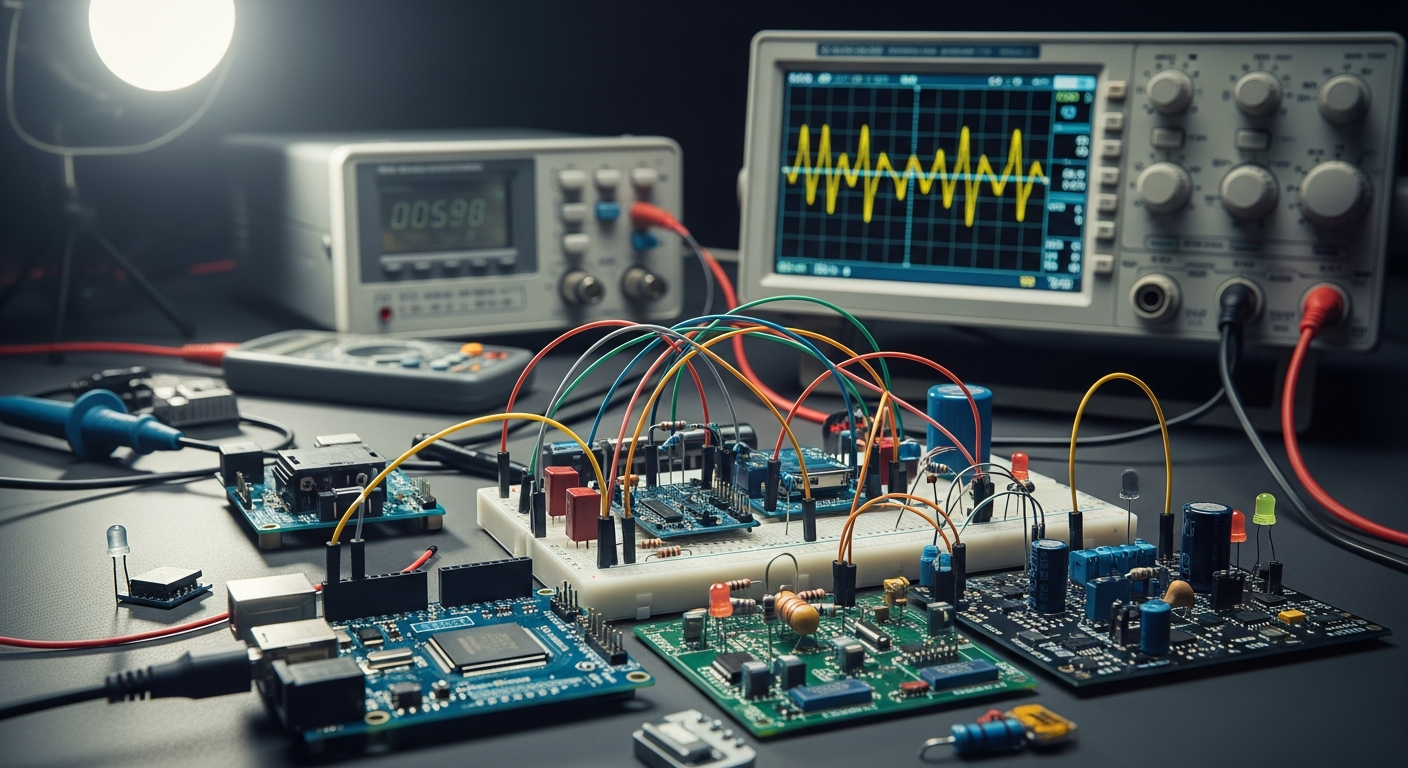
No kidding — oscillators are literally the “heartbeat” of every electronic system. They generate periodic waveforms (like sine, square, or triangular waves) without requiring any external input signal. Just power them up, and boom — they start singing on their own.
So let’s break this down like your favorite ECET senior explaining it over chai in the lab.
🔹 What is an Oscillator?
An oscillator is an electronic circuit that converts DC power into an AC signal (usually periodic).
Unlike amplifiers that amplify input signals, oscillators generate their own output using feedback.
The output is usually sinusoidal (like in RF circuits) or non-sinusoidal (like square waves in digital clocks).
🔹 Basic Idea
Let’s imagine you have an amplifier and feed a portion of its output back to its input in a smart way — with the right phase and right gain.
If you keep doing this properly, the circuit starts to generate a self-sustaining waveform.
That’s an oscillator!
🔹 Block Diagram (explained in words)
Think of it as three main blocks:
Amplifier → Feedback Network → Output (and part goes back to amplifier input)The feedback keeps the signal alive forever (ideally).
🔹 Condition for Sustained Oscillations – The Barkhausen Criterion
Now, this is the formula that ECET loves to ask.
The Barkhausen Criterion says:
- The loop gain (Aβ) must be equal to 1.

The phase shift around the loop must be 0° or 360° (so the signal reinforces itself).
If these two conditions are satisfied, the circuit keeps oscillating without dying out or exploding.
🔹 Types of Oscillators (ECET-Focused)
Let’s break them into two big families:
🌀 1. Sinusoidal Oscillators
Used in communication circuits, RF transmitters, and audio generators.
a) RC Oscillators (Low Frequency)
- Range: Audio frequencies (20 Hz to 20 kHz)
- Examples: RC Phase Shift Oscillator, Wien Bridge Oscillator
- Key idea: Uses resistor-capacitor phase shift networks.
b) LC Oscillators (High Frequency)
- Range: RF frequencies (100 kHz – 100 MHz)
- Examples: Hartley, Colpitts, Clapp Oscillators
- Key idea: Uses inductors and capacitors to set frequency.
c) Crystal Oscillators (Super Stable)
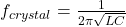
- Uses a quartz crystal as the frequency-selective element.
- Extremely stable — used in watches, microcontrollers, and communication systems.
⚡ 2. Non-Sinusoidal Oscillators
These generate square, triangular, or sawtooth waveforms — perfect for digital circuits.
Examples:
- Multivibrators (Astable, Monostable, Bistable)
- Relaxation Oscillators
🔹 Let’s Talk Frequency Formulae (The Juice of ECET!)
Each oscillator type has a specific formula for oscillation frequency. Let’s go through the common ones.
1. RC Phase Shift Oscillator
Uses three RC sections giving 60° phase shift each.

2. Wien Bridge Oscillator

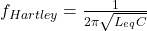
3. Hartley Oscillator
Uses two inductors and one capacitor.
where 
(M = mutual inductance between L1 and L2)
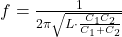
4. Colpitts Oscillator
Uses one inductor and two capacitors.
5. Crystal Oscillator

🔹 RC vs LC Oscillators – ECET Quick Comparison
| Feature | RC Oscillator | LC Oscillator |
|---|---|---|
| Frequency Range | Audio | Radio (RF) |
| Components | Resistors + Capacitors | Inductors + Capacitors |
| Frequency Stability | Moderate | High |
| Output Wave | Sine wave | Sine wave |
| Example | Wien Bridge | Hartley / Colpitts |
🔹 Real-Life Example
Open any microcontroller like 8051 or Arduino — there’s a tiny 12 MHz or 16 MHz crystal oscillator connected to it.
That’s the “clock” that makes every instruction execute in perfect timing.
Or check your FM radio circuit — a Colpitts oscillator is used for tuning and carrier generation.
Oscillators = timing + synchronization + communication.
Without them, electronics would be chaos.
⚙️ Formulas



🔟 10 MCQs
- In an oscillator, the Barkhausen criterion requires the loop gain to be:
A) Zero
B) Greater than one
C) Equal to one
D) Less than one - The frequency of oscillation of a Wien bridge oscillator is given by:
A)
B)
C)
D)
- Which oscillator uses two inductors and one capacitor?
A) Colpitts
B) RC Phase Shift
C) Hartley
D) Crystal - In an RC phase shift oscillator, total phase shift provided by feedback network is:
A) 90°
B) 120°
C) 180°
D) 270° - The condition for sustained oscillation is satisfied when:
A)
B)
C)
D)
- The frequency of a Hartley oscillator depends on:
A) Only capacitance
B) Only inductance
C) Both inductance and capacitance
D) Resistance only - Which type of oscillator gives the most stable frequency output?
A) RC Phase Shift
B) Wien Bridge
C) LC Oscillator
D) Crystal Oscillator - The feedback used in oscillators is:
A) Positive feedback
B) Negative feedback
C) Both A and B
D) None - A Colpitts oscillator consists of:
A) Two inductors and one capacitor
B) Two capacitors and one inductor
C) One inductor only
D) One capacitor only - In a Wien bridge oscillator, to start oscillations:
A) Loop gain < 1
B) Loop gain = 1
C) Loop gain > 1 initially
D) No feedback required
✅ Answer Key
Q.No Answer
1 C
2 A
3 C
4 C
5 A
6 C
7 D
8 A
9 B
10 C
🧠 Detailed Explanations
1️⃣ (C) – For sustained oscillations, Barkhausen criterion says .
2️⃣ (A) – Wien bridge frequency formula is .
3️⃣ (C) – Hartley oscillator = two inductors (L1, L2) + one capacitor (C).
4️⃣ (C) – Each RC section provides 60° phase shift, total = 180°, which complements the amplifier’s 180°.
5️⃣ (A) – ensures neither growing nor decaying oscillations.
6️⃣ (C) – Oscillation frequency depends on both L and C.
7️⃣ (D) – Crystal oscillators use quartz crystals → extreme frequency stability.
8️⃣ (A) – Positive feedback is essential for oscillation buildup.
9️⃣ (B) – Colpitts = two capacitors + one inductor.
10️⃣ (C) – Initially, loop gain > 1 to start oscillations; then adjusted to unity.
🎯 Motivation / Why This Topic Matters (ECET 2026)
Oscillators are must-know for every ECE student preparing for ECET 2026.
They appear every single year in some form — conceptual, numerical, or application-based.
Mastering this topic not only boosts your Analog Electronics marks but also strengthens your understanding of communication systems and embedded circuits.
Remember — every circuit needs a heartbeat, and oscillators give that life.
So keep practicing numericals, sketching block diagrams, and revising formulas.
Consistency wins ECET.
📲 CTA
Join our ECET 2026 ECE WhatsApp Group for daily quizzes & study notes:
https://chat.whatsapp.com/GniYuv3CYVDKjPWEN086X9

