



Concept Notes (Deep Explanation + Examples)
An oscillator is an electronic circuit that generates a repetitive AC signal (sine wave, square wave, etc.) without any external input signal.
It converts DC power into an AC waveform — this is why we call oscillators the heartbeat of electronic systems.
🧩 Basic Idea
Imagine a microphone test setup: when you speak into it, a continuous tone (“beep”) is produced during testing.
That sound originates from an oscillator — a circuit continuously producing alternating voltage.
⚙️ Definition
An oscillator is an electronic circuit that produces a periodic waveform at its output without requiring an external input signal.
Unlike an amplifier, which needs an input, oscillators self-generate signals using positive feedback and energy exchange between capacitors and inductors.
🔁 Amplifier vs Oscillator
| Feature | Amplifier | Oscillator |
|---|---|---|
| Input | Requires external signal | No external input |
| Output | Amplified version of input | Continuous AC waveform |
| Feedback | Negative feedback | Positive feedback |
| Function | Strengthens signals | Generates signals |
💡 Working Principle – Positive Feedback
Every oscillator has:
- Amplifying Device → Transistor or Op-Amp
- Feedback Network → Resistors, Capacitors, Inductors
- Energy Source (DC)
The Barkhausen Criterion determines the conditions for sustained oscillations:
1️⃣ Loop Gain = 1

2️⃣ Phase Shift = 0° or 360° (so that feedback reinforces input)
🔍 Classification of Oscillators
(A) Based on Component Type
| Type | Components Used | Example Output |
|---|---|---|
| LC Oscillators | Inductor + Capacitor | Sine wave |
| RC Oscillators | Resistor + Capacitor | Sine wave (audio) |
| Crystal Oscillators | Quartz crystal | Very stable sine wave |
| Relaxation Oscillators | Timing circuits | Square or sawtooth wave |
🧠 LC Oscillators (High Frequency)
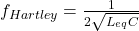
1️⃣ Hartley Oscillator: Uses two inductors (or tapped coil) and one capacitor.
Frequency:  , where
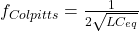
2️⃣ Colpitts Oscillator: Uses two capacitors and one inductor.
Frequency:  , where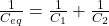
3️⃣ Clapp Oscillator: Improved Colpitts with an extra capacitor for stability.
⚙️ RC Oscillators (Low Frequency / Audio Range)
1️⃣ RC Phase Shift Oscillator:
Uses 3 RC sections giving 180° phase shift + 180° from amplifier = 360° total.
Frequency: 
2️⃣ Wien Bridge Oscillator:
Most popular audio oscillator. Produces distortion-free sine waves.
Frequency: 
🪶 Crystal Oscillator (High Stability)
- Uses piezoelectric crystal (quartz).
- Frequency depends on crystal’s natural vibration.
- Used in microcontrollers, watches, transmitters.
🧰 Real-Life Examples
- Microcontroller Clock (16 MHz crystal oscillator) – sets timing for instructions.
- Radio Transmitters – generate carrier signals.
- Signal Generators & Function Generators – lab instruments producing waveforms.
🔑 ECET Relevance
Oscillators are frequently asked in ECET ECE exams under:
- Electronic Devices & Circuits
- Communication Systems
- Analog Electronics
Common questions include Barkhausen criterion, frequency derivations, and type identification.
3️⃣ ⚙️ Formulas (Plain LaTeX)


4️⃣ 🔟 10 MCQs (GATE-level + ECET Mix)
- The condition for sustained oscillations is:
A)
B)
C)
D) None - The phase shift around an oscillator loop must be:
A) 90°
B) 180°
C) 270°
D) 0° or 360° - In a Colpitts oscillator, feedback is provided by:
A) Inductive divider
B) Capacitive divider
C) Resistive divider
D) Transformer - The Hartley oscillator uses:
A) Two capacitors and one inductor
B) Two inductors and one capacitor
C) Three resistors
D) Transformer only - The frequency of a Wien bridge oscillator is given by:
A)
B)
C)
D)
- A crystal oscillator is preferred for:
A) Low frequency generation
B) Unstable frequency
C) High stability
D) High distortion - The RC phase shift oscillator typically uses:
A) 1 RC section
B) 2 RC sections
C) 3 RC sections
D) 4 RC sections - The Barkhausen criterion does NOT include:
A) Loop gain = 1
B) Phase shift = 0° or 360°
C) Negative feedback
D) Positive feedback - Wien bridge oscillator is used for:
A) RF frequency range
B) Audio frequency range
C) Microwave range
D) Digital circuits - The function of feedback network in oscillator is to:
A) Reduce noise
B) Maintain oscillation
C) Increase bandwidth
D) Rectify signal
5️⃣ ✅ Answer Key
Q.No Answer
1 B
2 D
3 B
4 B
5 A
6 C
7 C
8 C
9 B
10 B
6️⃣ 🧠 Detailed Explanations
Q1: Correct → B. Sustained oscillations need unity loop gain .
Q2: D. Total phase shift = 0° or 360° ensures regenerative feedback.
Q3: B. Colpitts uses a capacitive divider for feedback.
Q4: B. Hartley oscillator has two inductors (or a tapped coil) and one capacitor.
Q5: A. Wien bridge frequency =  .
.
Q6: C. Crystal oscillators are known for frequency stability due to the piezoelectric effect.
Q7: C. Three RC sections provide 180° phase shift.
Q8: C. Barkhausen criterion requires positive, not negative feedback.
Q9: B. Wien bridge oscillator is best for audio frequency generation (20 Hz – 20 kHz).
Q10: B. Feedback maintains continuous oscillation by supplying energy lost in each cycle.
7️⃣ 🎯 Motivation / Why This Topic Matters (ECET 2026)
Oscillators form the timing backbone of every communication and embedded system.
Mastering oscillators helps you easily score marks in Analog Circuits and Communication Systems sections of ECET.
Practice frequency formulas, types, and feedback conditions regularly — these 2–3 questions can boost your rank by 500+ positions if you get them right.
Consistency beats cramming — study daily and simulate small oscillator circuits on Multisim or Falstad to strengthen your understanding!
8️⃣ 📲 CTA
Join our ECET 2026 ECE WhatsApp Group for daily quizzes & study notes:
👉 https://chat.whatsapp.com/GniYuv3CYVDKjPWEN086X9

