



CONCEPT NOTES (Deep Explanation + Examples)
🔹 What is a Register?
A register is a small group of flip-flops used to store and transfer binary data in digital systems.
Each flip-flop stores 1 bit, so an n-bit register can hold n bits of information.
Think of it like a tiny memory box inside your microprocessor — temporary, fast, and essential for data manipulation.
🔹 Internal Structure
Imagine 4 flip-flops connected side by side — each holds one bit (Q0–Q3).
These are controlled by a common clock signal that synchronizes data movement.
🧠 Diagram explained in words:
Picture four D flip-flops connected in a row, all sharing the same clock.
Input lines D0–D3 feed each flip-flop. Outputs Q0–Q3 together form a 4-bit register.
🔹 Purpose of Registers
Registers are used for:
- Temporary data storage
- Data transfer between CPU and memory
- Arithmetic and logical operations
- Shifting, counting, buffering in circuits
They are the heart of microcontrollers, CPUs, and communication devices.
🔹 Types of Registers
Registers are classified based on how data moves in or out.
1️⃣ Parallel Load Register
- Data is loaded simultaneously into all flip-flops.
- Very fast.
- Example: Temporary storage registers in ALU.
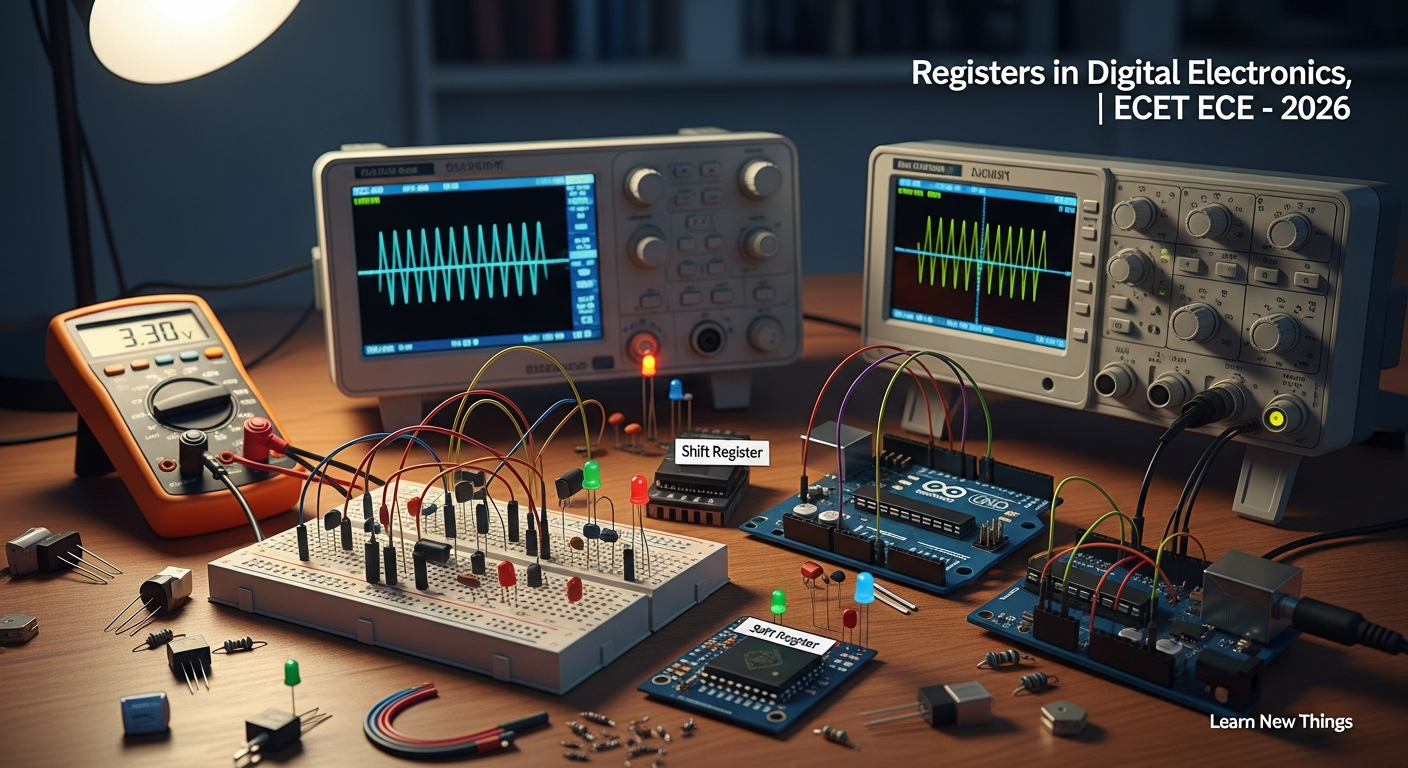
2️⃣ Shift Register
- Data moves bit by bit through flip-flops.
- Controlled by clock pulses.
- Used for serial communication.
Types:
- SISO – Serial In Serial Out
(e.g., data transmitted bit-by-bit between two devices) - SIPO – Serial In Parallel Out
(used in serial-to-parallel converters) - PISO – Parallel In Serial Out
(used in UART transmitters) - PIPO – Parallel In Parallel Out
(used in microprocessor data buses)
🧩 Example:
If 1010 is entered serially (bit by bit), after 4 clock pulses, all bits appear at the output — like a conveyor belt moving bits down the line.
🔹 Shift Register Operation Example
Suppose we use four D flip-flops to make a SISO register:
- Input sequence: 1 → 0 → 1 → 1
- After each clock pulse, bits “shift” to the next flip-flop.
At the 4th clock, the output = 1011.
🔹 Applications of Registers
- Data storage in microprocessors
- Serial to Parallel and Parallel to Serial conversion
- Counters and delay elements
- Digital signal processing
- Communication buffers in modems, UARTs, and data buses
🔹 Real-Life Examples
- Inside your Arduino or 8051, registers like Accumulator (A), B-register, PSW, and Data Register store data during computation.
- Shift registers like 74HC595 are used in LED display control via serial input.
🔹 ECET Relevance
Registers form an essential part of the ECET Digital Electronics syllabus.
You can expect 2–3 direct questions — often numerical on shift timing, serial-parallel conversion, or flip-flop count.
3️⃣ ⚙️ FORMULAS (Plain LaTeX)





4️⃣ 🔟 10 MCQs (GATE-level + ECET Mix)
1️⃣ A 4-bit register can store how many different binary values?
A) 4
B) 8
C) 16
D) 32
2️⃣ In a shift register, data movement is controlled by:
A) Data enable
B) Clock pulses
C) Load signal
D) Reset pin
3️⃣ A PISO register is mainly used for:
A) Serial to parallel conversion
B) Parallel to serial conversion
C) Counting
D) Memory addressing
4️⃣ How many flip-flops are required for an 8-bit register?
A) 2
B) 4
C) 8
D) 16
5️⃣ Which register type is fastest for data transfer?
A) Serial
B) Shift
C) Parallel
D) Counting
6️⃣ The IC 74HC595 is an example of:
A) SISO
B) SIPO
C) PISO
D) PIPO
7️⃣ In a shift register, after 3 clock pulses, how many bits shift?
A) 1
B) 2
C) 3
D) 4
8️⃣ A 4-bit shift register can delay data by:
A) 1 bit
B) 2 bits
C) 3 bits
D) 4 bits
9️⃣ Which of the following is used for serial-to-parallel data conversion?
A) SIPO register
B) PISO register
C) SISO register
D) PIPO register
10️⃣ The storage capacity of a 12-bit register is:
A) 6 bits
B) 8 bits
C) 12 bits
D) 24 bits
5️⃣ ✅ ANSWER KEY (WordPress Table Format)
Q.No Answer
1 C
2 B
3 B
4 C
5 C
6 B
7 C
8 D
9 A
10 C
6️⃣ 🧠 DETAILED EXPLANATIONS
1️⃣ → C:
A 4-bit register can store 24=16 different combinations (0000 to 1111).
2️⃣ → B:
Shift operation happens with each clock pulse, moving bits one stage forward.
3️⃣ → B:
PISO stands for Parallel-In Serial-Out, converting parallel input into serial output — ideal for UART transmission.
4️⃣ → C:
Each flip-flop = 1 bit → 8-bit register = 8 flip-flops.
5️⃣ → C:
Parallel registers load all bits simultaneously → fastest data transfer.
6️⃣ → B:
74HC595 takes serial input and gives parallel output — a SIPO shift register.
7️⃣ → C:
Each clock pulse shifts one bit → 3 pulses shift 3 bits.
8️⃣ → D:
A 4-bit register delays data by 4 clock cycles → 4-bit delay line.
9️⃣ → A:
Serial data enters one by one and exits parallel → SIPO register.
10️⃣ → C:
Storage capacity = 12 bits (one per flip-flop).
7️⃣ 🎯 MOTIVATION / WHY THIS TOPIC MATTERS (ECET 2026)
Registers form the foundation of every digital system — from flip-flops to microcontrollers.
In ECET, mastering registers boosts your speed in logic analysis, circuit timing, and communication understanding.
Most toppers revise shift register questions daily because they appear in Digital Electronics, Microprocessors, and Communication sections too.
💪 Keep practicing, visualize data flow, and you’ll score full marks easily in this area.
8️⃣ 📲 CTA (Fixed)
Join our ECET 2026 ECE WhatsApp Group for daily quizzes & study notes:
👉 https://chat.whatsapp.com/GniYuv3CYVDKjPWEN086X9

