



Concept Notes (Deep Explanation + Examples)
🔹 Introduction
In power systems, cables are the silent carriers of electricity — like veins carrying blood through our body.
They transmit power from one point to another safely and efficiently.
Cables are used when overhead lines are not feasible — such as in underground systems, cities, industrial complexes, and substations.
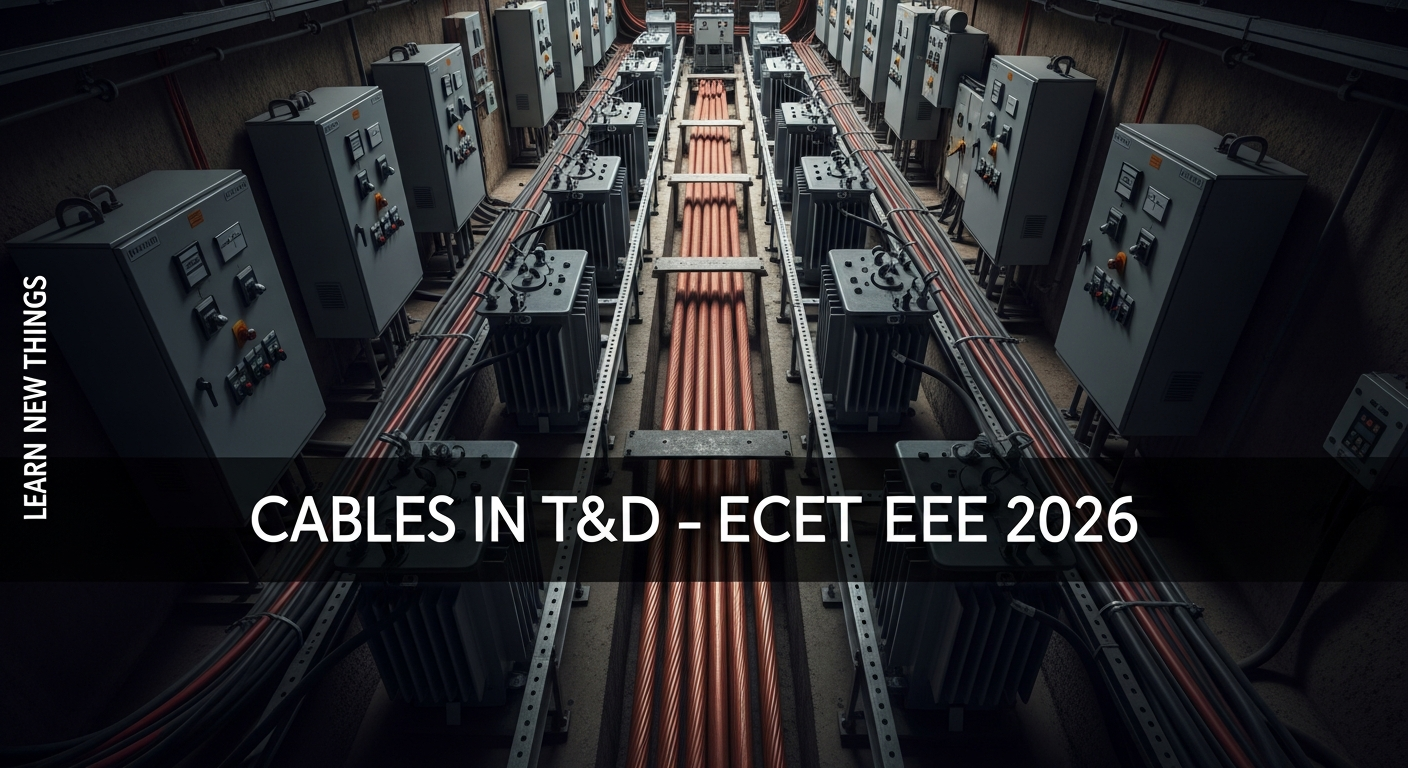
In Transmission & Distribution (T&D), cables form the distribution backbone — connecting transformers, panels, and consumer points.
🔹 Basic Structure of a Cable
A typical electrical cable consists of five main parts:
1️⃣ Conductor – carries electric current
2️⃣ Insulation – prevents current leakage
3️⃣ Metallic sheath – protects against moisture and mechanical damage
4️⃣ Bedding – separates sheath from armouring
5️⃣ Armour – provides mechanical protection
6️⃣ Outer sheath – final layer against weather, chemical, or environmental damage
🧠 Analogy:
Think of the cable like a human nerve:
- Conductor = Nerve fiber (carries impulse)
- Insulation = Nerve covering (protects from leakage)
- Armour = Bone structure (protects from damage)
🔹 Types of Cables (Based on Voltage)
| Type | Voltage Range | Example Use |
|---|---|---|
| Low Voltage (LV) | up to 1 kV | Domestic wiring |
| High Voltage (HV) | 11 kV – 33 kV | Industrial supply |
| Extra High Voltage (EHV) | 33 kV – 132 kV | Transmission |
| Super High Voltage (SHV) | Above 132 kV | Grid level transmission |
🔹 Types of Cables (Based on Insulating Material)
- VIR (Vulcanized India Rubber):
Used in early systems; flexible but degrades over time.
⚠️ Not used much today. - PVC (Polyvinyl Chloride):
Common in domestic wiring — cheap, durable, moisture-resistant. - XLPE (Cross-Linked Polyethylene):
Modern standard for underground cables; high temperature & voltage tolerance.
✅ Used widely in T&D systems. - Paper Insulated Lead Sheathed Cable (PILC):
Used for HV systems earlier — now replaced by XLPE.
🔹 Electrical Parameters of Cables
- Capacitance (C):
Due to insulation between conductors and sheath.
High capacitance causes charging current.
(where = permittivity, A = area, d = distance)
 - Inductance (L):
Caused by magnetic field around conductors.

Resistance (R):
Opposes current flow.

Dielectric Strength:
Maximum voltage the insulation can withstand before breakdown.
🔹 Laying of Underground Cables
Cables are laid in trenches with sand cushioning, protective bricks, and warning tiles.
They must be away from water lines and other utilities.
In power plants or substations, cables are placed in cable trays or tunnels for safety and maintenance.
🔹 Faults in Cables
Common faults include:
- Open circuit fault – conductor broken
- Short circuit fault – insulation failure
- Earth fault – conductor touches earth or sheath
Murray loop and Varley loop tests are used for fault location.
🔹 Advantages of Underground Cables
✅ No weather impact
✅ Aesthetic & safe
✅ Low maintenance
✅ Less voltage drop
However:
❌ High initial cost
❌ Difficult to locate faults
❌ Cooling & heat dissipation issues
🔹 Practical Site Examples
- In urban substations, XLPE 11 kV 3-core cables connect distribution transformers.
- In control panels, PVC cables connect relays, contactors, and circuit breakers.
- Industries often use armoured cables between MCCs (Motor Control Centers) and motors.
⚙️ Formulas (Plain LaTeX Only)






🔟 10 MCQs (GATE + ECET Mixed)
- The main function of cable insulation is to
A) Carry current
B) Provide mechanical strength
C) Prevent leakage current
D) Reduce resistance - The most commonly used insulation for modern HV cables is
A) Rubber
B) Paper
C) PVC
D) XLPE - The capacitance of a cable depends on
A) Length and insulation thickness
B) Type of conductor only
C) Only current rating
D) None - The dielectric loss in a cable is proportional to
A) Voltage
B)
C)
D) Frequency only - The fault occurring when conductor touches earth is called
A) Short circuit
B) Open circuit
C) Earth fault
D) Dielectric failure - Which test is used for locating faults in underground cables?
A) Hopkinson test
B) Murray loop test
C) Swinburne test
D) Megger test - Underground cables are preferred for
A) Rural areas
B) Temporary supply
C) Urban areas
D) Hill stations only - The main disadvantage of underground cables is
A) High maintenance
B) Voltage fluctuation
C) Difficult fault location
D) Safety issues - The armouring of cable is used to
A) Prevent current leakage
B) Protect from mechanical damage
C) Reduce inductance
D) Improve insulation - The charging current in a cable increases with
A) Decrease in capacitance
B) Increase in capacitance
C) Increase in resistance
D) Decrease in voltage
✅ Answer Key
Q.No Answer
1 C
2 D
3 A
4 B
5 C
6 B
7 C
8 C
9 B
10 B
🧠 MCQ Explanations (Step-by-Step)
1️⃣ → C:
Insulation prevents leakage current between conductor and earth/sheath.
2️⃣ → D:
Modern cables use XLPE due to high dielectric strength & thermal resistance.
3️⃣ → A:
Capacitance depends on length and insulation thickness (distance between conductors).
4️⃣ → B:
Dielectric loss = .
5️⃣ → C:
When conductor touches earth = Earth fault.
6️⃣ → B:
Murray loop test uses bridge principle to locate cable faults.
7️⃣ → C:
In cities (urban areas), overhead lines are avoided → underground cables used.
8️⃣ → C:
Main disadvantage = Fault location is difficult & costly repair.
9️⃣ → B:
Armour layer protects from external mechanical stress or crush.
🔟 → B:
Charging current ∝ Capacitance → more capacitance = more charging current.
🎯 Motivation / Why Practice Matters (ECET 2026 EEE)
Cables appear very frequently in ECET — especially in Power Systems and Transmission & Distribution sections.
Concepts like capacitance, faults, and types of cables form the base for power plant and distribution jobs.
Understanding cables helps students visualize real-world power networks — from substations to homes.
Every successful electrical engineer must grasp insulation, protection, and voltage rating concepts.
💡 Remember:
“Strong basics in EEE = Strong connections in life!”
Keep revising, stay consistent, and your ECET rank will rise like voltage in a step-up transformer! ⚡
📲 CTA (Fixed)
Join our ECET 2026 EEE WhatsApp Group for daily quizzes & study notes:
https://chat.whatsapp.com/GniYuv3CYVDKjPWEN086X9

