



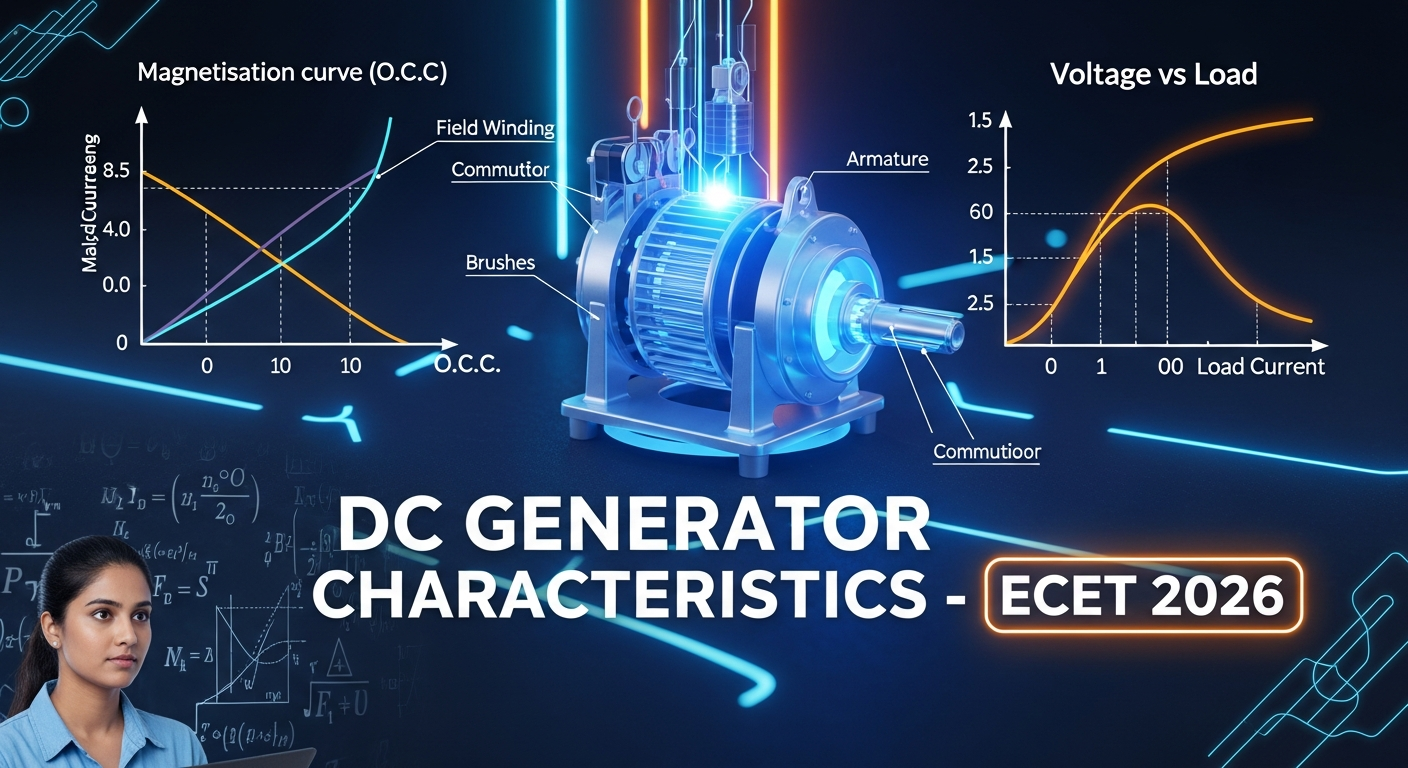
Why This Topic Is Important for ECET 2026
DC Generator Characteristics are one of the most asked DC Machines topics in ECET.
Many questions come on:
- Types of characteristics
- Shape of curves
- Relations between generated EMF, load current & terminal voltage
- Conditions for self-excitation
- Effects of series, shunt, compound connections
Understanding these curves helps you solve higher-level topics like voltage regulation, building-up process, and load performance.
📘 Concept Notes – Characteristics of DC Generators
DC generators have three major characteristics, which help us understand how output voltage and current behave under different operating conditions.
1️⃣ Open Circuit Characteristic (O.C.C.) – No Load / Magnetisation Curve
This is the graph between:
- Generated EMF (E) on Y-axis
- Field Current (If) on X-axis
Important Points:
- It is drawn at rated speed.
- Curve starts at a non-zero value due to residual magnetism.
- Initially linear, later saturates.
- Used to determine field resistance line and build-up condition.
Condition for Self-Excitation:
Self-excitation occurs when:

If field resistance is too high → generator fails to build up voltage.
2️⃣ Internal Characteristic (E – IL curve)
This is the curve between:
- Generated EMF (E)
- Armature current (Ia)
Why is E less than O.C.C. value?
Because of armature reaction:

Internal characteristic lies below O.C.C. due to demagnetizing effect.
3️⃣ External Characteristic (V – IL curve)
This shows the relationship between:
- Terminal voltage (V)
- Load current (IL)
Given by:
where for shunt generators.
For series generators:

The external characteristic lies below internal characteristic due to the voltage drop:
- Armature resistance drop
- Brush drop
- Armature reaction
📌 Types of DC Generators & Their Characteristics
🔵 1. Shunt Generator Characteristics
- Voltage drops gradually with increase in load.
- Cannot start without residual magnetism.
- Poor voltage regulation.
- Terminal voltage decreases due to:
- Field weakening
- Armature reaction
- IaRa drop
🔴 2. Series Generator Characteristics
- Voltage increases sharply with load (initially).
- After saturation, voltage drops.
- Rarely used commercially.
Reason:
Field current = load current → high sensitivity.
🟢 3. Compound Generator Characteristics
Two types:
- Cumulatively compounded
- Better than shunt
- Used for distribution systems
- Nearly constant terminal voltage
- Differentially compounded
- Voltage falls rapidly
- NOT used in practice
⚙️ Formulas (QuickLaTeX only)
- EMF Equation:

Terminal voltage of shunt generator:

Shunt field current:

Armature current:
Series generator terminal voltage:

Condition for build-up:

🔟 10 MCQs (ECET + GATE Mixed Level)
Q1. The O.C.C. of a DC generator does NOT depend on:
a) Speed
b) Residual magnetism
c) Field resistance
d) Field current
Q2. The external characteristic of a shunt generator:
a) Rises with load
b) Falls with load
c) Remains constant
d) First rises then falls
Q3. In a shunt generator, drop from internal to external characteristic is due to:
a) Saturation
b) Stray losses
c) Armature reaction + IaRa drop
d) Only field resistance
Q4. Self-excitation occurs if:
a) Field resistance < critical resistance
b) Field resistance > critical resistance
c) Field resistance = critical resistance
d) None
Q5. For a series generator, the terminal voltage:
a) Always decreases
b) Always increases
c) Initially increases then decreases
d) Remains constant
Q6. A cumulatively compounded generator used for:
a) Traction
b) Constant voltage loads
c) Communication circuits
d) Battery charging
Q7. If Ra increases in a shunt generator, the external characteristic:
a) Becomes steeper
b) Becomes flatter
c) Shifts upward
d) Doesn’t change
Q8. A shunt generator fails to build up if:
a) Residual magnetism is zero
b) Field resistance is high
c) Wrong field polarity
d) All of the above
Q9. Voltage regulation depends mainly on:
a) Armature reaction
b) IaRa drop
c) Field current
d) Both (a) and (b)
Q10. For constant speed, the O.C.C. curve:
a) Linear
b) Exponential
c) Linear initially then saturates
d) Constant
✅ Answer Key
| Q.No | Answer |
|---|---|
| 1 | c |
| 2 | b |
| 3 | c |
| 4 | a |
| 5 | c |
| 6 | b |
| 7 | a |
| 8 | d |
| 9 | d |
| 10 | c |
🧠 MCQ Explanations (Step-by-Step)
Q1 → (c)
O.C.C. is a plot of E vs. If.
- Speed affects E → Yes
- Residual magnetism gives starting EMF → Yes
- Field current → direct variable
Field resistance doesn’t affect the O.C.C. itself.
Q2 → (b)
Shunt generator terminal voltage decreases as load increases:
Ia increases → voltage drop increases → V decreases.
Q3 → (c)
Difference between internal & external =

Q4 → (a)
Self-excitation needs:

Q5 → (c)
Series generator saturates → voltage increases then drops due to armature reaction.
Q6 → (b)
Cumulative compound gives nearly constant voltage → perfect for distribution.
Q7 → (a)
Higher Ra → more drop → curve becomes steeper.
Q8 → (d)
All are required for build-up.
Q9 → (d)
Voltage regulation depends on both armature reaction and IaRa.
Q10 → (c)
O.C.C. increases linearly at first then saturates due to iron saturation.
🎯 Motivation / Why Practice Matters
DC Generator Characteristics questions test your conceptual clarity + curve interpretation.
In ECET 2026:
- Almost 2–3 direct questions come from DC Machines.
- Speed matters—understanding the nature of curves helps answer without calculation.
- Strong basics = strong performance in Transformers, Induction Machines & Power Systems later.
Practicing these MCQs gives you a real competitive edge!
📲 CTA
👉 Join our WHATSAPP group for ECET 2026 updates and discussions:
https://chat.whatsapp.com/GniYuv3CYVDKjPWEN086X9

