



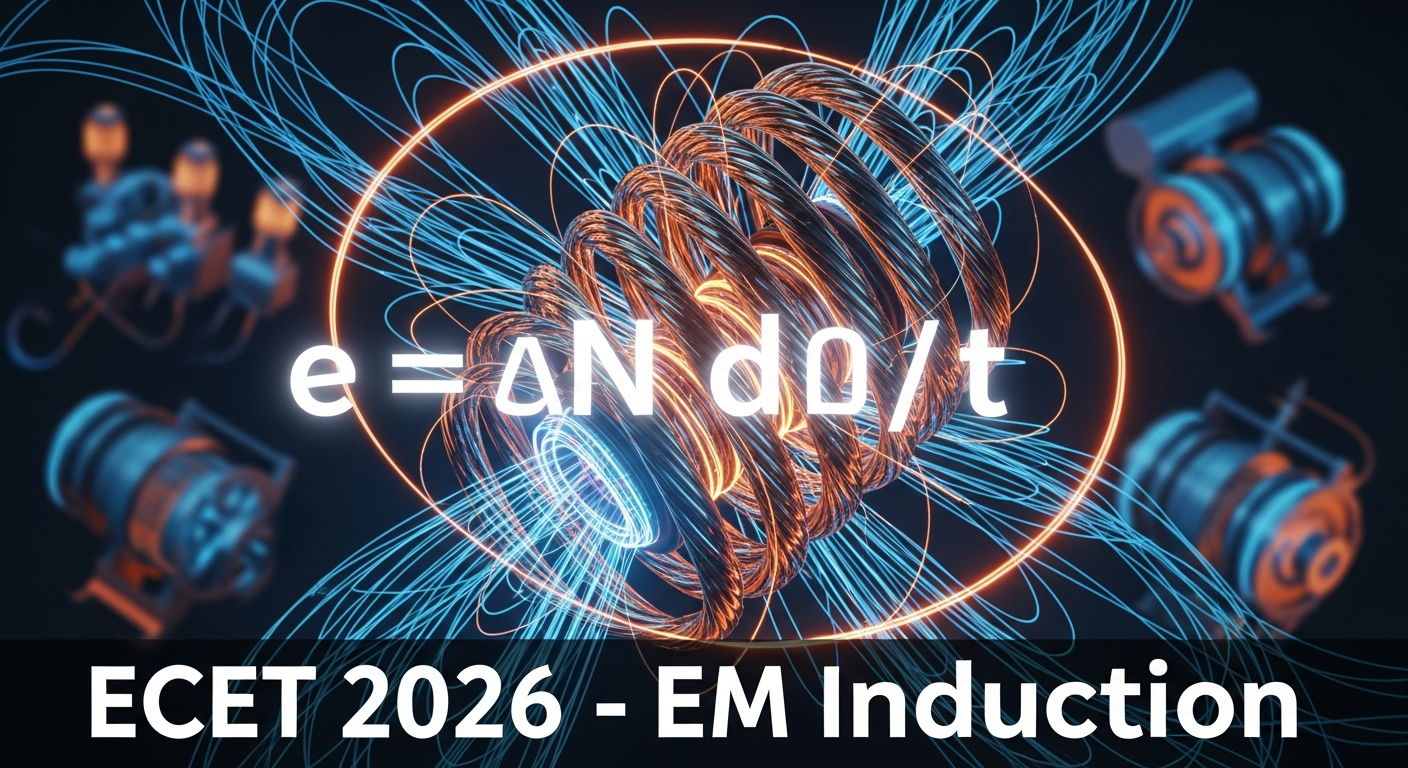
Why This Topic Is Important for ECET 2026 (EEE)
Electromagnetic Induction is one of the core concepts used in Transformers, DC Machines, AC Machines, Power Systems, EV motors, and Generators.
In ECET, 3–6 marks directly come from this concept through formulas, flux, induced EMF, Faraday’s laws, Lenz’s law, and coil-based numerical problems.
If your EM Induction basics are strong → machines becomes easy, and so does Power Electronics & EV concepts.
📘 Concept Notes – Electromagnetic Induction (Deep, Simple, Exam-Ready)
1. What is Electromagnetic Induction?
When magnetic flux through a closed coil changes, an EMF (voltage) is induced.
This is called Electromagnetic Induction.
It is the working principle of:
- Transformers
- Generators
- Inductors
- Relays
- EV motors
- Alternators
2. Magnetic Flux
Magnetic flux is the measure of magnetic field passing through a surface.
Formula:
Where:
 → Magnetic flux density
 → Area
 → Angle between field and normal
3. Faraday’s Laws of Electromagnetic Induction
First Law:
EMF is induced whenever magnetic flux linking a coil changes.
Second Law:
Induced EMF is directly proportional to the rate of change of flux.
Formula:
Negative sign → Lenz’s Law (opposes the cause).
4. Lenz’s Law
The direction of induced EMF is such that it opposes the change that produces it.
This explains back EMF, eddy currents, and energy conservation.
5. Induced EMF in Different Cases
(a) Average Induced EMF

(b) RMS Value of Induced EMF in Alternator Coil

Very important for AC Machines & Transformers.
(c) Motional EMF
If a conductor moves inside a magnetic field:

Where:
 → length of conductor
 → velocity
Used in DC generators.
6. Self & Mutual Induction
Self-Inductance (L)
Induced EMF due to changing current in the same coil:

Mutual Inductance (M)
Induced EMF in another coil:

⚙️ All Formulas (QuickLaTeX Only)



🔟 MCQs (Conceptual + Numerical + GATE-Level)
Q1. Magnetic flux unit is:
a) Weber
b) Tesla
c) Henry
d) Ampere
Q2. If a coil of 200 turns experiences a flux change of 0.05 Wb in 0.1 sec, induced EMF?
a) 50 V
b) 100 V
c) 200 V
d) 300 V
Q3. Faraday’s law deals with:
a) Current
b) Voltage
c) Induced EMF
d) Resistance
Q4. If  , conductor length
  , velocity
  , motional EMF:
a) 0.2 V
b) 0.6 V
c) 1.2 V
d) 2 V
Q5. Formula applies to:
a) DC Generator
b) Transformer
c) Transmission Line
d) Battery
Q6. Lenz’s law is based on:
a) Kirchhoff’s law
b) Law of conservation of energy
c) Coulomb’s law
d) Gauss law
Q7. When flux increases, direction of induced EMF:
a) Supports change
b) Opposes change
c) Random
d) None
Q8. If  and
and  , find induced EMF.
a) 1 V
b) 2 V
c) –2 V
d) –1 V
Q9. In mutual induction, induced EMF depends on:
a) Rate of change of current in other coil
b) Coil resistance
c) Voltage applied
d) Power factor
Q10. A rotating coil generator works on:
a) Fleming’s right-hand rule
b) Fleming’s left-hand rule
c) Joule’s law
d) Lami’s theorem
✅ Answer Key (WordPress-Friendly Table)
| Q.No | Ans |
|---|---|
| 1 | a |
| 2 | b |
| 3 | c |
| 4 | c |
| 5 | b |
| 6 | b |
| 7 | b |
| 8 | c |
| 9 | a |
| 10 | a |
🧠 Explanations (Step-By-Step, With QuickLaTeX Only)
Q1 → a
Flux unit is Weber.
Tesla is flux density.
Q2 → b

Q3 → c
Faraday explains induced EMF, not current or voltage directly.
Q4 → c ?
?
Wait → correct multiplication is:
 → (c)
→ (c)
Q5 → b
This formula is the RMS EMF equation of a transformer winding.
Q6 → b
Lenz’s law = Energy conservation principle → opposes the cause.
Q7 → b
By Lenz’s law, induced EMF opposes the change.
Q8 → c

Q9 → a
Mutual EMF depends on current change in other coil:

Q10 → a
Generators use Fleming’s Right-Hand Rule (induced EMF rule).
🎯 Motivation / Why Practice Matters (ECET 2026 EEE)
Electromagnetic Induction directly appears in transformers, machines, power systems, EV motor theory, and wind energy generators.
In ECET, questions come in mixed numerical + conceptual style, so practicing daily improves:
- Speed in flux & EMF calculations
- Accuracy in sign conventions (negative sign from Lenz’s law)
- Confidence in machine formulas
- Ability to score 5–7 marks just from this chapter
If you master EM Induction → Machines & Power Systems become super easy, giving you a competitive score edge.
📲 CTA
👉 Join our WHATSAPP group for ECET 2026 updates and discussions →
https://chat.whatsapp.com/GniYuv3CYVDKjPWEN086X9

