




Concept Notes (Deep Explanation + Examples)
🔹 Introduction
Belt drives are mechanical systems used to transmit power between two shafts using flexible belts. They are widely used in workshops, lathes, drilling machines, conveyors, and compressors. The main advantage is that they can transmit power between shafts that are not directly connected and can absorb shocks and vibrations.
In ECET and diploma workshops, you often see belt drives connecting electric motors to machines — such as in milling or lathe setups.
🔹 Basic Working Principle
The belt runs over two pulleys – the driver pulley (connected to the power source) and the driven pulley (connected to the machine).
When the driver pulley rotates, frictional force between the belt and pulley surface transmits motion and power to the driven pulley.
If friction is not enough, slip occurs. So, angle of contact, belt tension, and coefficient of friction play crucial roles.
🔹 Types of Belt Drives
1. Open Belt Drive
- Shafts rotate in the same direction.
- Used when distance between shafts is moderate.
- Example: Lathe and motor connection.
2. Cross Belt Drive
- Shafts rotate in opposite directions.
- Increases angle of contact, hence more power transmitted.
- Slight rubbing occurs on belt, reducing belt life.
3. Compound Belt Drive
- Power transmitted between multiple shafts using several pulleys and belts.
- Used when power has to be transmitted over long distances.
4. Stepped or Cone Pulley Drive
- Uses multiple pulleys of different diameters on a common shaft.
- Used where variable speed is required — e.g., drilling machines.
5. Fast and Loose Pulley Drive
- Allows engaging and disengaging the driven shaft easily.
- Common in line shaft workshops.
🔹 Types of Belts
- Flat Belt – Used for long distances and moderate power.
- V-Belt – Used for short distances, high power, no slip.
- Circular (Rope) Belt – Used for long distances and heavy loads.
🔹 Velocity Ratio (V.R.)
The velocity ratio of a belt drive is defined as the ratio of speed of driver to speed of driven:

where:
 = speed of driver (rpm)
 = speed of driven (rpm)
 = diameter of driver pulley
 = diameter of driven pulley
If thickness of belt is considered:

🔹 Slip in Belt Drives
Due to insufficient friction or load variation, belt slips over the pulley.
If slip % = s, then:

Slip reduces speed and efficiency.
🔹 Centrifugal Tension
When the belt runs at high speed, the belt mass experiences a centrifugal force which adds an extra tension:

where  = mass per meter length,
  = velocity of belt.
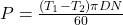
🔹 Power Transmitted by a Belt
Power = (Effective Tension) × Velocity

where:
 = tension in the tight side
 = tension in the slack side
- = belt velocity (m/s)
🔹 Tension Ratio on Tight and Slack Side
From the law of belting:

where:
 = coefficient of friction
 = angle of lap (in radians)
🔹 Practical Example
Suppose a 0.1 m thick flat belt runs over pulleys of 0.6 m and 0.3 m diameters. The motor runs at 1000 rpm.
Speed of driven pulley:

🔹 Real-World Workshop Example
In a lathe machine, a motor drives the main spindle using a V-belt.
Changing the pulley step changes spindle speed — this is how speed control is achieved mechanically without electronics.
3️⃣ ⚙️ Formulas (Plain LaTeX, NO boxes)



4️⃣ 🔟 10 MCQs (GATE level + ECET mix)
- In an open belt drive, the shafts rotate in:
A) Opposite directions
B) Same direction
C) Perpendicular direction
D) Random direction - Velocity ratio of belt drive neglecting thickness is:
A)
B)
C)
D)
- Which belt type is used for short center distance and high power?
A) Flat belt
B) Rope belt
C) V-belt
D) Chain - Centrifugal tension in belt is given by:
A)
B)
C)
D)
- For maximum power transmission, belt velocity should be:
A) Very low
B) Very high
C) Optimum
D) Zero - Power transmitted by a belt is given by:
A)
B)
C)
D)
- In a cross belt drive, the angle of contact is:
A) Less than open belt
B) Equal to open belt
C) More than open belt
D) Zero - If slip is 2%, velocity ratio decreases by:
A) 0.02
B) 2%
C) 0.2%
D) 20% - Which pulley combination provides variable speed in a lathe?
A) Cone pulley
B) Fixed pulley
C) Idler pulley
D) Taper pulley - The law of belting is represented by:
A)
B)
C)
D)
5️⃣ ✅ Answer Key (WordPress Table Format — NOT HTML)
Q.No Answer
1 B
2 B
3 C
4 A
5 C
6 A
7 C
8 B
9 A
10 A
6️⃣ 🧠 MCQ Explanations
1️⃣ B — In an open belt drive, both pulleys rotate in the same direction.
2️⃣ B — V.R. = (neglecting thickness).
3️⃣ C — V-belts are ideal for short distance & high power transmission.
4️⃣ A — Centrifugal tension formula is .
5️⃣ C — Too high speed causes slip; too low reduces power → optimum velocity needed.
6️⃣ A — Power = (Effective Tension) × Velocity =  .
.
7️⃣ C — Cross belt drive increases angle of contact → better grip.
8️⃣ B — Slip of 2% → 2% reduction in velocity ratio.
9️⃣ A — Cone pulley drive allows stepwise speed variation in machines.
10️⃣ A — The fundamental law of belting is  .
.
7️⃣ 🎯 Motivation (ECET 2026 Specific)
Belt drives are repeatedly asked in ECET Mechanical because they form the core of machine power transmission systems.
Understanding formulas and types helps you solve design and workshop-related questions easily.
Keep practicing such concepts daily — small consistent effort builds strong mechanical intuition and boosts ECET rank.
8️⃣ 📲 CTA (Always Fixed)
Join our ECET 2026 Mechanical WhatsApp Group for daily quizzes & study notes:
👉 https://chat.whatsapp.com/GniYuv3CYVDKjPWEN086X9

