


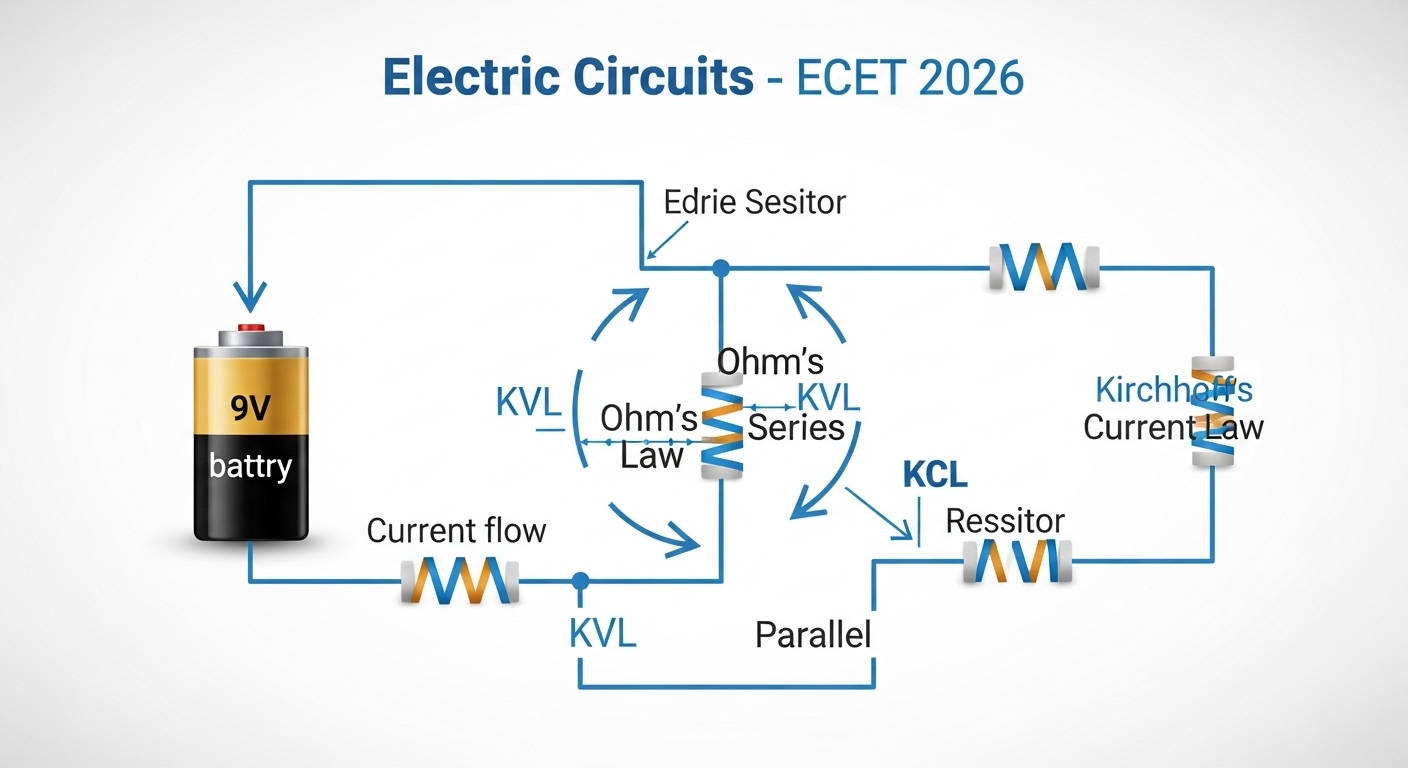
In ECET 2026 Physics, Electric Circuits is a crucial and easy-to-score topic. Questions are frequently asked from Ohm’s Law, Kirchhoff’s Voltage Law (KVL), and Kirchhoff’s Current Law (KCL). Mastering these helps in solving both theoretical and numerical questions easily.
📘 Concept Notes
⚡ What is an Electric Circuit?
An electric circuit is a closed conducting path through which current flows due to the potential difference provided by a power source (battery or cell).
🔹 Ohm’s Law
Statement:
The current passing through a conductor is directly proportional to the potential difference applied across it, provided temperature and other physical conditions remain constant.
Formula:

Where:
 → Voltage (Volts)
 → Current (Amperes)
 → Resistance (Ohms,
  )
)
Example:
If  and
and  , then

🔹 Kirchhoff’s Laws
1️⃣ Kirchhoff’s Current Law (KCL)
Statement:
At any junction in an electrical circuit, the sum of currents entering the junction equals the sum of currents leaving the junction.
Formula:

Example:
If 3A and 2A enter a junction and one branch carries 4A out, then the remaining current leaving is:

2️⃣ Kirchhoff’s Voltage Law (KVL)
Statement:
In any closed loop of a circuit, the sum of all voltages (potential rises and drops) is equal to zero.
Formula:
or

Example:
If in a loop,
- Battery = 12V
- Resistor 1 drop = 4V
- Resistor 2 drop = 8V
Then total: → Satisfies KVL ✅
🔹 Equivalent Resistance Formulas
- Series Connection:

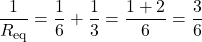
Parallel Connection:

Example:
For two resistors  ,
,  in parallel:
→ 
🔟 10 Expected MCQs – ECET 2026
Q1. Ohm’s Law states the relationship between:
A) Power, Voltage, Resistance
B) Current, Voltage, Resistance
C) Charge, Current, Resistance
D) Energy, Current, Voltage
Q2. The unit of resistance is:
A) Ampere
B) Volt
C) Ohm
D) Watt
Q3. If  and
and  , then
A) 2A
B) 4A
C) 5A
D) 20A
Q4. KCL is based on:
A) Conservation of charge
B) Conservation of energy
C) Conservation of momentum
D) None
Q5. KVL is based on:
A) Conservation of energy
B) Conservation of charge
C) Conservation of current
D) None
Q6. In a parallel circuit, the voltage across each branch is:
A) Different
B) Same
C) Zero
D) Infinite
Q7. If three resistors 2Ω, 3Ω, and 5Ω are in series, total resistance = ?
A) 10Ω
B) 5Ω
C) 2Ω
D) 15Ω
Q8. If 2A and 3A currents enter a junction, and 4A leaves, remaining current leaving = ?
A) 1A
B) 2A
C) 3A
D) 5A
Q9. Which law gives the voltage distribution in a closed circuit?
A) KCL
B) KVL
C) Ohm’s Law
D) Faraday’s Law
Q10. Equivalent resistance of two equal resistors in parallel = ?
A) 
B) 
C) 
D) 
✅ Answer Key
| Q.No | Answer |
|---|---|
| Q1 | B |
| Q2 | C |
| Q3 | C |
| Q4 | A |
| Q5 | A |
| Q6 | B |
| Q7 | A |
| Q8 | A |
| Q9 | B |
| Q10 | B |
🧠 Explanations
- Q1 → B: Ohm’s Law links voltage, current, and resistance.
- Q2 → C: Resistance unit is Ohm (Ω).
- Q3 → C:
 .
. - Q4 → A: KCL is derived from charge conservation.
- Q5 → A: KVL is derived from energy conservation.
- Q6 → B: In parallel, voltage remains the same across branches.
- Q7 → A: Series total = 2 + 3 + 5 = 10Ω.
- Q8 → A: (2 + 3) – 4 = 1A leaves.
- Q9 → B: KVL applies to voltage distribution.
- Q10 → B:
 .
.
🎯 Why Practice Matters
- Electric circuits are frequently asked in ECET every year.
- Questions are conceptual and formula-based → Easy marks if practiced daily.
- Understanding Ohm’s Law and Kirchhoff’s Laws helps in solving network and current flow problems.