



Why This Topic Is Important for ECET
Gas power cycles form the foundation of IC engines, gas turbines, and power plants, which contribute to 10–12 marks every year in ECET Mechanical.
If you understand how Otto, Diesel, and Brayton cycles work, you can solve numerical + conceptual questions easily.
This topic improves your thermodynamics grip, boosts accuracy, and helps in speed-based problem solving.
📘 Concept Notes – Gas Power Cycles (Deep, Simple Explanation)
A gas power cycle is a thermodynamic cycle in which the working fluid (usually air) remains in gaseous state throughout the process.
These cycles are used to model the operation of:
- Petrol engines → Otto cycle
- Diesel engines → Diesel cycle
- Gas turbines → Brayton/Joule cycle
- Hot-air engines → Stirling & Ericsson cycles
Gas cycles assume air-standard analysis:
- Air behaves as an ideal gas
- Specific heats (Cp, Cv) are constant
- Compression & expansion are reversible and adiabatic
- Combustion is replaced with heat addition
- Exhaust is replaced with heat rejection
🔹 1. Otto Cycle (SI engines – Petrol Cars & Bikes)
Processes:
1–2: Isentropic compression
2–3: Constant volume heat addition
3–4: Isentropic expansion
4–1: Constant volume heat rejection
Efficiency depends only on compression ratio (r):
Higher r → higher efficiency → reason modern engines use high compression.
🔹 2. Diesel Cycle (CI engines – Trucks, Tractors)
Processes:
1–2: Isentropic compression
2–3: Constant pressure heat addition
3–4: Isentropic expansion
4–1: Constant volume heat rejection
Efficiency depends on:
- Compression ratio (r)
- Cut-off ratio (rc)
Diesel cycle efficiency is less than Otto cycle for same r.
🔹 3. Dual Cycle (Semi-Diesel Engines)
Heat addition at:
- Constant volume
- Constant pressure
It lies between Otto and Diesel cycles → engine behavior in real world.
🔹 4. Brayton / Joule Cycle (Gas Turbines – Aircraft, Power Plants)
Processes:
1–2: Isentropic compression
2–3: Constant pressure heat addition
3–4: Isentropic expansion
4–1: Constant pressure heat rejection
Used in:
- Jet engines
- Gas turbine plants
- Aircraft propulsion
🔹 5. Stirling Cycle
Two isothermal + two constant volume processes.
Used in low-temperature engines.
🔹 6. Ericsson Cycle
Isothermal compression + expansion with regeneration.
Highest possible efficiency among gas cycles (equals Carnot).
⚙️ Formulas (QuickLaTeX format only)
Otto Cycle Efficiency

Diesel Cycle Efficiency

Dual Cycle Efficiency

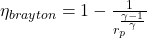
Brayton Cycle Efficiency
Air-standard efficiency relation

Compression Ratio

Cut-off Ratio

🔟 10 MCQs – Conceptual + Numerical
Q1. Otto cycle efficiency mainly depends on:
a) Heat added
b) Compression ratio
c) Pressure ratio
d) Cut-off ratio
Q2. For the same compression ratio, which cycle has the highest efficiency?
a) Diesel
b) Dual
c) Otto
d) Brayton
Q3. Brayton cycle is used in:
a) Petrol engines
b) Gas turbines
c) Steam turbines
d) Stirling engines
Q4. For a gas turbine, efficiency increases with:
a) Lower pressure ratio
b) Higher pressure ratio
c) Lower turbine inlet temperature
d) Higher compressor work
Q5. If compression ratio increases in Otto cycle, efficiency:
a) Decreases
b) Remains constant
c) Increases
d) First increases then decreases
Q6. Diesel cycle efficiency depends on compression ratio and:
a) Pressure ratio
b) Cut-off ratio
c) Temperature ratio
d) Gamma ratio only
Q7. In Brayton cycle, heat addition occurs at:
a) Constant volume
b) Constant pressure
c) Constant temperature
d) Constant entropy
Q8. In air-standard analysis, air is assumed as:
a) Real gas
b) Incompressible
c) Ideal gas
d) Mixture of gases
Q9. The relation of efficiencies is:
a) Diesel > Dual > Otto
b) Otto > Dual > Diesel
c) Dual > Otto > Diesel
d) Otto = Diesel = Dual
Q10. A petrol engine works on which cycle?
a) Diesel
b) Brayton
c) Otto
d) Dual
✅ Answer Key (WordPress Table Compatible)
| Q | Ans |
|---|---|
| 1 | b |
| 2 | c |
| 3 | b |
| 4 | b |
| 5 | c |
| 6 | b |
| 7 | b |
| 8 | c |
| 9 | b |
| 10 | c |
🧠 Explanations
Q1: Otto cycle efficiency depends only on compression ratio → (b).
Q2: Otto > Dual > Diesel for same r → (c).
Q3: Brayton = gas turbines → (b).
Q4: Higher pressure ratio increases net work & efficiency → (b).
Q5: Higher r gives higher η → (c).
Q6: Diesel η depends on r and cut-off ratio rc → (b).
Q7: Brayton = constant pressure heat addition → (b).
Q8: Air-standard assumes ideal gas → (c).
Q9: Standard relation: Otto > Dual > Diesel → (b).
Q10: Petrol engines follow Otto cycle → (c).
🎯 Motivation / Why Practice Matters
Gas power cycle questions in ECET are formula-based but conceptual.
Mastering these cycles helps you:
- Solve 8–12 marks quickly
- Increase speed in thermal problems
- Reduce careless mistakes
- Gain confidence in numerical solving
Consistent practice = competitive edge in ECET 2026.
Your goal should be accuracy + speed.
📲 CTA
👉 Join our WHATSAPP group for ECET 2026 updates and discussions:
https://chat.whatsapp.com/GniYuv3CYVDKjPWEN086X9

