


Concept Notes (Deep Explanation + Examples)
🔹 1. Why Wrapper Classes Exist (The Basic Need)
In Java, primitive data types (int, double, char, etc.) are not objects.
But many Java features work only with objects, such as:
- Collections (ArrayList, HashMap)
- Generics
- Frameworks & APIs
- Object-based utilities
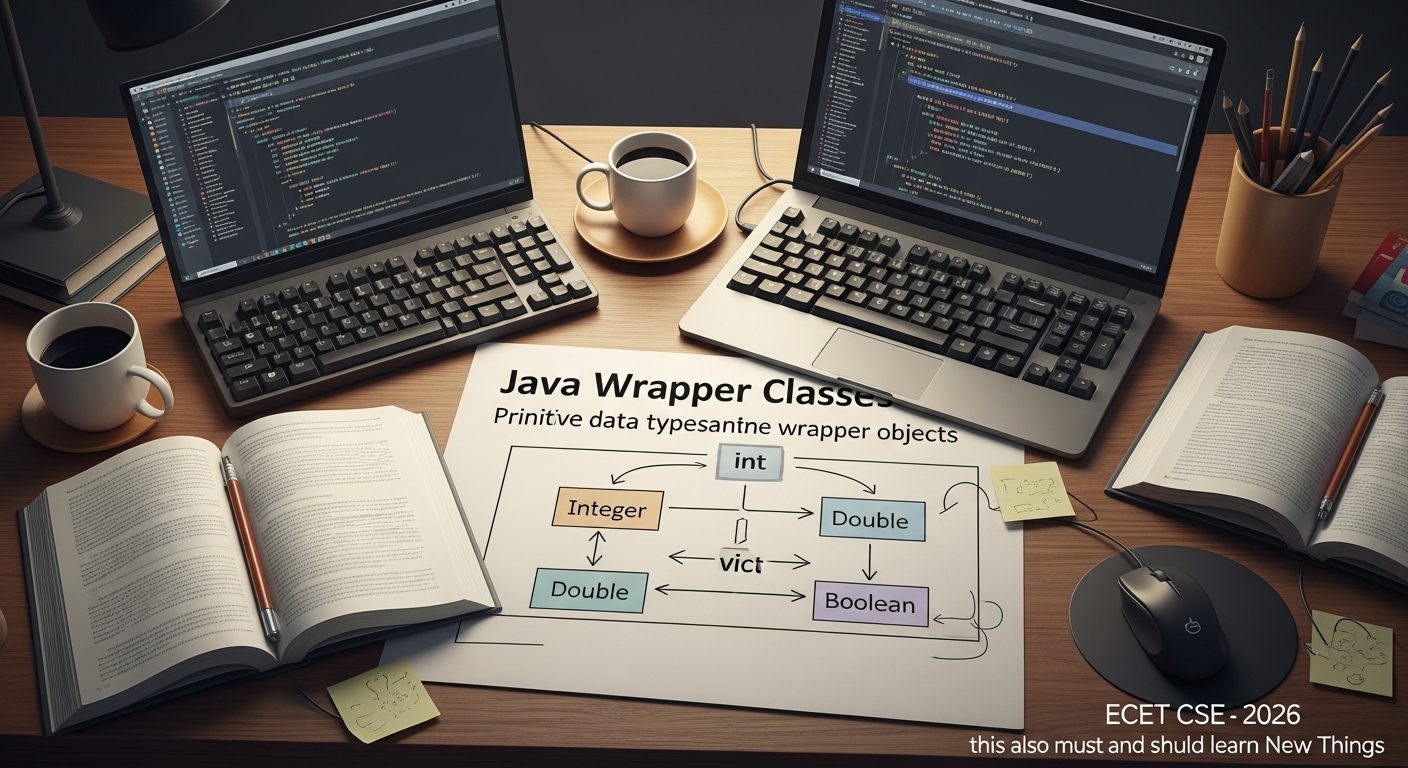
👉 To bridge this gap, Java provides Wrapper Classes.
| Primitive | Wrapper Class |
|---|---|
| int | Integer |
| double | Double |
| char | Character |
| boolean | Boolean |
| float | Float |
| long | Long |
| short | Short |
| byte | Byte |
💡 Exam Point: Wrapper classes are part of java.lang package (import not required).
🔹 2. What is a Wrapper Class?
A Wrapper Class converts a primitive value into an object.
Example:
int a = 10;
Integer obj = Integer.valueOf(a);Now obj behaves like an object and can be used in collections.
📌 Real-world analogy:
Primitive = raw data
Wrapper = data packed in a box so it can be transported anywhere
🔹 3. Autoboxing (Primitive → Object)
Autoboxing means Java automatically converts a primitive into its wrapper class.
Example:
int x = 20;
Integer y = x; // Autoboxing👉 No need to call valueOf() explicitly.
📌 Where it happens?
- Adding elements to ArrayList
- Passing primitives to methods expecting objects
ArrayList<Integer> list = new ArrayList<>();
list.add(5); // Autoboxing happens here💡 ECET Tip: Autoboxing introduced in Java 5
🔹 4. Unboxing (Object → Primitive)
Unboxing converts a wrapper object back to a primitive.
Example:
Integer p = 30;
int q = p; // UnboxingInternally:
int q = p.intValue();📌 Important:
If wrapper object is null, unboxing causes NullPointerException
🔹 5. Wrapper Class Methods (Very Important for MCQs)
| Method | Use |
|---|---|
parseInt() | Converts String → primitive |
valueOf() | Converts primitive/String → object |
toString() | Converts object → String |
compareTo() | Compares two objects |
Example:
int a = Integer.parseInt("100");
Integer b = Integer.valueOf("200");💡 Exam Trap:parseInt() returns primitivevalueOf() returns object
🔹 6. Wrapper Classes & Collections (Exam Favorite)
Collections cannot store primitives.
❌ Invalid:
ArrayList<int> list;✅ Valid:
ArrayList<Integer> list;Autoboxing automatically converts int → Integer.
🔹 7. Performance & Memory (ECET Theory Point)
- Primitives → Faster, less memory
- Wrapper Objects → Slower, more memory
- Use wrappers only when objects are required
📌 ECET Question Pattern:
Which is faster? → Primitive types
⚙️ Formulas (Plain LaTeX, No Boxes)
👉 No mathematical formulas applicable for Java Wrapper Classes & Autoboxing
🔟 10 MCQs (ECET + GATE Hybrid)
Q1. Which package contains wrapper classes?
A. java.util
B. java.io
C. java.lang
D. java.wrapper
Q2. Autoboxing was introduced in which Java version?
A. Java 1.2
B. Java 1.4
C. Java 5
D. Java 8
Q3. Which wrapper class is used for char?
A. String
B. Character
C. Char
D. Boolean
Q4. What does Integer.parseInt("50") return?
A. Integer object
B. String
C. int primitive
D. Boolean
Q5. Which collection can store integers?
A. ArrayList<int>
B. ArrayList<Integer>
C. int ArrayList
D. None
Q6. Unboxing converts:
A. Object to Object
B. Primitive to Object
C. Object to Primitive
D. String to Object
Q7. Which causes NullPointerException?
A. Autoboxing
B. Unboxing null object
C. valueOf()
D. parseInt()
Q8. Which method returns a wrapper object?
A. parseInt()
B. intValue()
C. valueOf()
D. toString()
Q9. Wrapper classes are mainly used with:
A. Loops
B. Arrays
C. Collections
D. Operators
Q10. Which is faster in execution?
A. Wrapper class
B. Objects
C. Primitive data type
D. String
✅ Answer Key (WordPress Table — NO HTML)
Q No | Answer
1 | C
2 | C
3 | B
4 | C
5 | B
6 | C
7 | B
8 | C
9 | C
10 | C
🧠 MCQ Explanations
Q1: Wrapper classes belong to java.lang → auto imported.
Other packages do not contain wrapper classes.
Q2: Autoboxing/unboxing came in Java 5 only.
Q3: Character wraps char. Others are invalid.
Q4: parseInt() converts String → primitive int.
Q5: Collections need objects → Integer not int.
Q6: Unboxing = Object → Primitive.
Q7: Unboxing a null wrapper causes NullPointerException.
Q8: valueOf() returns wrapper object.
Q9: Wrapper classes are used mainly in Collections Framework.
Q10: Primitive types consume less memory and execute faster.
🎯 Motivation (ECET 2026 Specific)
Wrapper Classes & Autoboxing are guaranteed theory + MCQ topics in ECET CSE.
One clear question almost every year comes from this area.
Mastering this topic strengthens your Java + Collections foundation, directly boosting your rank.
👉 Small topics, big marks — revise daily!
📲 CTA (Fixed)
Join our ECET 2026 CSE WhatsApp Group for daily quizzes & study notes:
https://chat.whatsapp.com/GniYuv3CYVDKjPWEN086X9