



Concept Notes (Deep Explanation + Examples)
🔹 Introduction
A Lightning Arrestor (LA) is one of the most vital protection devices in power systems.
Its main function is to protect electrical equipment like transformers, generators, and transmission lines from high-voltage surges caused by lightning strokes or switching surges.
When lightning strikes a transmission line, a surge voltage travels along the line toward substations or electrical machines. If not controlled, this surge can damage insulation, burn windings, or destroy equipment instantly.
That’s where a Lightning Arrestor comes in — it diverts these dangerous surges safely to the ground.
⚡ Real-World Analogy:
Think of a Lightning Arrestor as a safety valve — just like a pressure relief valve releases excess steam in boilers, the lightning arrestor releases excess voltage to the earth.
🔹 Working Principle
The Lightning Arrestor works on the principle of providing a low-resistance path to the surge voltage so that it bypasses the equipment and flows directly to the ground.
Under normal operating conditions, the LA does nothing – it behaves like an open circuit.
But when a high-voltage surge occurs, its resistance suddenly drops, allowing the surge to pass to the earth. Once the surge subsides, it returns to its normal high-resistance state, restoring the system.
🔹 Construction & Components
A typical lightning arrestor consists of:
- Spark gap – air gap that breaks down during surges
- Non-linear resistor (ZnO or SiC) – conducts high current during surges
- Earthing lead – connects LA to ground
- Housing – porcelain or polymer insulation for weather resistance
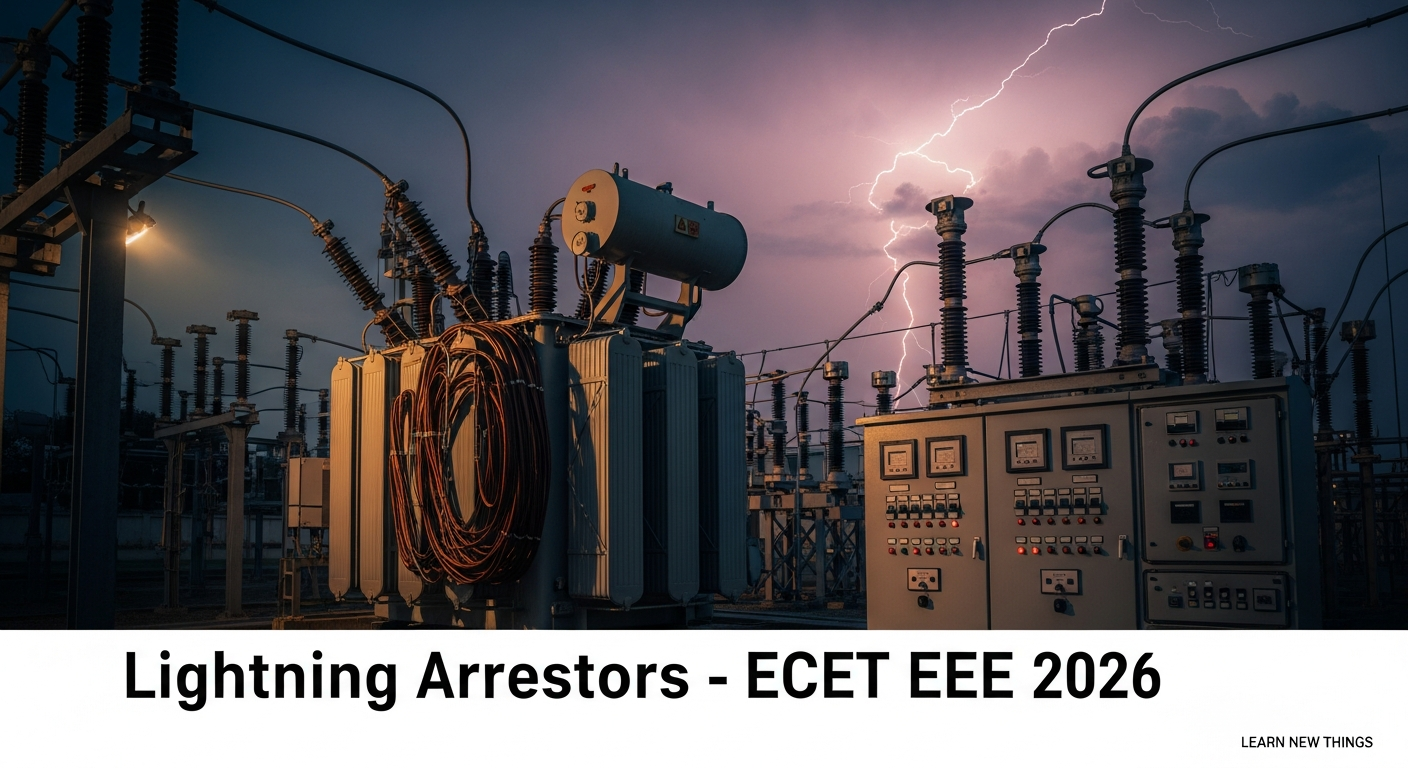
📍In substations, these are mounted near transformers or circuit breakers on support structures.
🔹 Types of Lightning Arrestors
| Type | Description | Application |
|---|---|---|
| 1. Rod Gap Arrestor | Two metal rods with an air gap; cheapest but less reliable | Low-voltage systems |
| 2. Sphere Gap Arrestor | Two metal spheres with adjustable gap | Laboratory setups |
| 3. Horn Gap Arrestor | Two horn-shaped electrodes; arc rises and extinguishes naturally | Distribution lines |
| 4. Multi-gap Arrestor | Series of gaps with resistors for higher voltage | Substations |
| 5. Valve Type Arrestor (ZnO Arrestor) | Non-linear resistor + multiple gaps; best performance | High-voltage transmission systems |
🔹 Site Example:
In 132 kV substations, ZnO-type lightning arrestors are installed on each phase near transformer bushings.
They are connected between the line and earth mat. During a surge, they instantly discharge the surge current to the ground, saving the expensive transformer.
🔹 Important ECET Points:
- Lightning Arrestors are always connected in parallel with the equipment to be protected.
- ZnO arrestors are most widely used today.
- LA must have a very good earth connection (low resistance).
- Location: Always installed at the entry point of a line to a substation or building.
- After operation, arrestors self-restore — no manual resetting needed.
⚡ Example (Practical Understanding)
Imagine a 11 kV feeder line entering a distribution transformer yard.
If lightning strikes the line 2 km away, a surge of ~100 kV may travel towards the transformer.
The ZnO lightning arrestor immediately provides a path to ground, discharging the surge and keeping the transformer safe.
Without it, the transformer’s insulation would fail instantly.
3️⃣ ⚙️ Formulas (Plain LaTeX Only)


4️⃣ 🔟 10 MCQs (GATE + ECET Mixed)
- The main function of a lightning arrestor is to:
A) Step down voltage
B) Protect equipment from surges
C) Measure voltage
D) Interrupt fault current - Lightning arrestors are connected:
A) In series with circuit
B) In parallel with equipment
C) Across earth only
D) Across neutral only - The commonly used material in modern arrestors is:
A) Silicon Carbide
B) Zinc Oxide
C) Copper Oxide
D) Carbon - A horn gap arrestor extinguishes the arc by:
A) Magnetic blowout
B) Arc rising due to hot air
C) Vacuum
D) Cooling coil - The location of a lightning arrestor in a substation is:
A) Near transformer
B) At control panel
C) Inside circuit breaker
D) On earthing mat only - Valve-type arrestors are used for:
A) Low voltage
B) Medium voltage
C) High voltage
D) DC systems only - Which of the following behaves as a non-linear resistor?
A) ZnO block
B) Copper wire
C) Carbon brush
D) Aluminium foil - The insulation level of equipment is decided considering:
A) Rated voltage
B) Power factor
C) Surge voltage
D) Frequency - During normal operation, a lightning arrestor acts as:
A) Short circuit
B) Open circuit
C) Fuse
D) Inductor - The best protection device for 132 kV systems is:
A) Horn gap
B) Multi-gap
C) ZnO type
D) Rod gap
5️⃣ ✅ Answer Key (WordPress Table Format — NO HTML)
Q.No Answer
1 B
2 B
3 B
4 B
5 A
6 C
7 A
8 C
9 B
10 C
6️⃣ 🧠 MCQ Explanations (Step-by-Step)
1️⃣ → (B) Lightning arrestor protects equipment from surge voltages. Others like transformers or meters don’t perform this function.
2️⃣ → (B) LAs are always connected in parallel with the equipment. Series connection would interrupt supply.
3️⃣ → (B) Modern arrestors use Zinc Oxide (ZnO) due to superior non-linear characteristics.
4️⃣ → (B) Horn gap arrestor’s arc rises due to hot air and extinguishes naturally.
5️⃣ → (A) Lightning arrestors are placed near transformers or line entry points.
6️⃣ → (C) Valve-type arrestors handle high voltages in transmission networks.
7️⃣ → (A) ZnO block behaves as a non-linear resistor, reducing resistance during surges.
8️⃣ → (C) Surge voltage decides insulation level of electrical equipment.
9️⃣ → (B) Under normal conditions, the arrestor is an open circuit (no conduction).
🔟 → (C) For 132 kV systems, ZnO arrestors offer the best protection.
7️⃣ 🎯 Motivation / Why Practice Matters (ECET 2026 EEE)
Lightning arrestors are one of the most repeated ECET topics from Power Systems Protection.
Every student must understand how they safeguard equipment and why correct installation & earthing matter.
Mastering this concept helps you solve substation-based numericals and also improves understanding of switchgear and protection systems.
These basics are your foundation for B.Tech subjects like “High Voltage Engineering” and “Protection & Switchgear”.
🔋 Remember — a strong foundation in protection devices makes you a smart electrical engineer who can save entire systems from failure.
⚡ Consistency creates rank. Learn one concept daily — practice it, visualize it, and you’ll electrify your ECET 2026 journey.
8️⃣ 📲 CTA (Fixed)
Join our ECET 2026 EEE WhatsApp Group for daily quizzes & study notes:
👉 https://chat.whatsapp.com/GniYuv3CYVDKjPWEN086X9

