



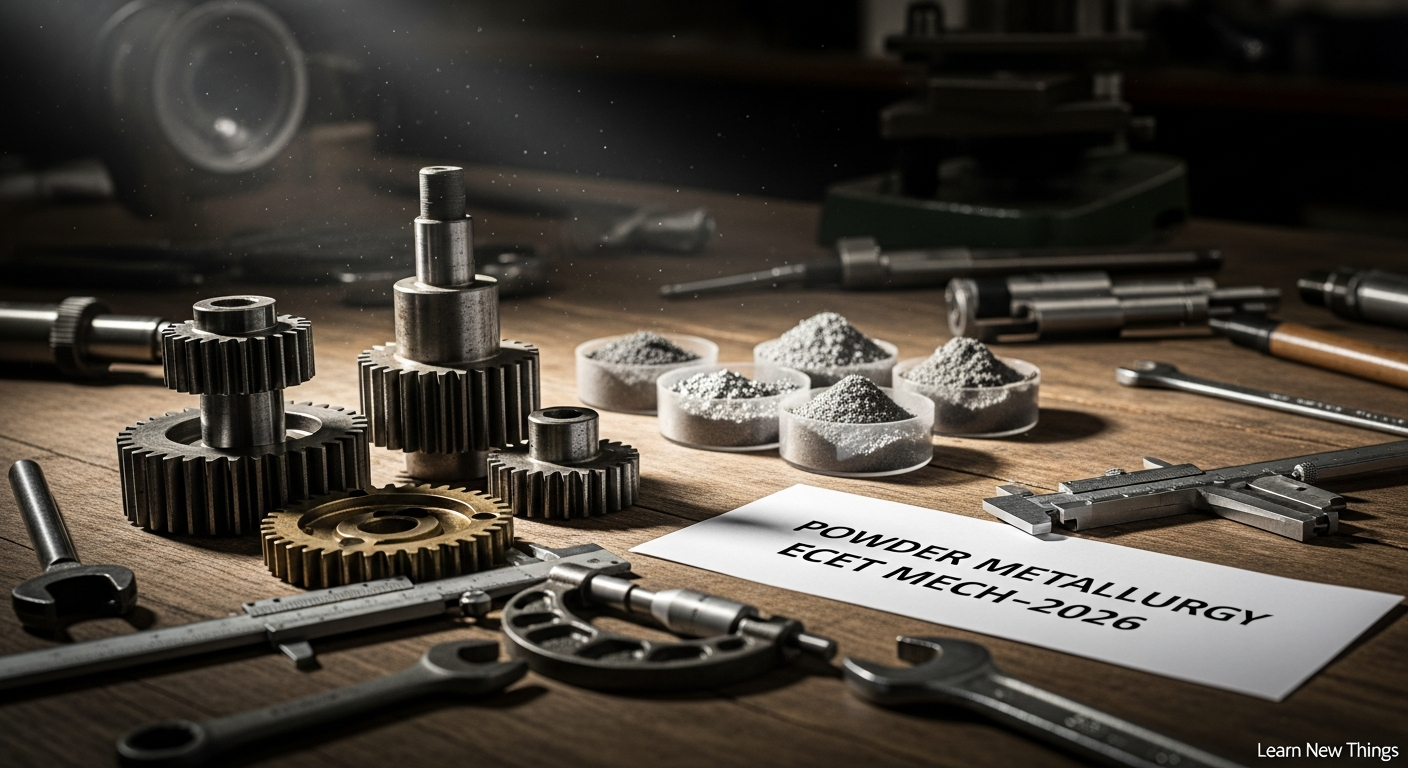
Concept Notes (Deep Explanation + Examples)
🔧 Introduction
Powder Metallurgy (PM) is a modern manufacturing process used to produce components by compacting metal powders and then sintering them at high temperatures below their melting point.
It is a clean, economical, and highly efficient method used in automobile, aerospace, and tool-making industries.
In ECET, questions from this topic appear every year — mainly on steps, advantages, limitations, and applications.
🏭 Basic Idea
Instead of casting molten metal or machining it, powder metallurgy starts with metal powder.
This powder is pressed into a desired shape (known as a green compact) and then heated (sintered) so that the particles bond together to form a solid part.
The process minimizes waste, improves material utilization, and allows for making parts that are difficult or impossible to produce by conventional methods.
⚙️ Main Steps in Powder Metallurgy Process
Let’s understand the five major steps clearly:
1️⃣ Powder Production
Metal powders are produced by several methods:
- Mechanical Methods: Crushing, milling, machining.
- Chemical Methods: Reduction, electrolysis.
- Atomization: Molten metal is broken into fine particles using a jet of air, water, or inert gas. (Most common)
Example: Iron, copper, and aluminum powders are produced by atomization.
2️⃣ Blending (or Mixing)
- Powders of different metals/alloys are blended to ensure uniform composition.
- Lubricants like graphite or stearic acid are added to improve flow and reduce friction during pressing.
Example: Copper and tin powders are mixed to produce bronze parts.
3️⃣ Compaction (Pressing)
- The blended powder is pressed into a die under high pressure (100–1000 MPa).
- The shape obtained is called a green compact.
- It has enough strength to be handled but is still porous.
Practical Workshop Analogy: Like pressing wet clay into a mold — the clay holds its shape even before baking.
4️⃣ Sintering
- The green compact is heated in a furnace below the melting point of the main metal.
- The metal particles bond (diffuse) together, increasing strength and density.
- Sintering atmosphere is controlled (hydrogen, vacuum, or inert gas) to prevent oxidation.
Example: Iron compacts are sintered around 1100°C in hydrogen.
5️⃣ Finishing Operations
Optional processes to improve dimensional accuracy, surface finish, or strength:
- Sizing: Repressing to improve accuracy.
- Impregnation: Filling pores with oil or resin.
- Infiltration: Filling with low-melting metal like copper.
- Heat treatment, machining, or plating can also be done.
🧩 Advantages of Powder Metallurgy
- Near-net shape – less machining required
- High material utilization (up to 95%)
- Uniform properties
- Ability to produce complex shapes
- Controlled porosity (used in self-lubricating bearings)
- Excellent surface finish
⚠️ Limitations
- High cost of metal powders
- Not suitable for large components
- High tooling cost
- Density control can be challenging
⚙️ Applications
- Automobile parts: Gears, cams, bearings, pistons
- Aerospace: Turbine blades
- Medical: Dental and surgical tools
- Electrical: Contact points, magnetic materials
🔬 Real-Life Workshop Insight
In mechanical workshops, powder metallurgy components are identified by their smooth surface, fine grain structure, and low machining marks.
Self-lubricating bronze bearings in electric motors and fans are direct examples of powder metallurgy parts.
3️⃣ ⚙️ Formulas (Plain LaTeX, NO boxes)




4️⃣ 🔟 10 MCQs (GATE + ECET mix)
- The process of compacting metal powder under high pressure is called:
A) Blending
B) Compaction
C) Sintering
D) Atomization - The main purpose of sintering is to:
A) Increase porosity
B) Remove impurities
C) Bond metal particles together
D) Reduce melting point - Atomization is a method of:
A) Compaction
B) Powder production
C) Sintering
D) Machining - The temperature range of sintering is approximately:
A) 0.2–0.4 of melting point
B) 0.4–0.6 of melting point
C) 0.7–0.9 of melting point
D) Equal to melting point - The green compact has:
A) High strength
B) No porosity
C) Low strength and porosity
D) Completely fused particles - In powder metallurgy, impregnation is used to:
A) Improve surface finish
B) Fill pores with oil or resin
C) Increase weight
D) Reduce density - Powder metallurgy is best suited for:
A) Large components
B) Simple parts
C) Small, complex parts
D) Wrought products - The lubricant in powder metallurgy is used to:
A) Increase strength
B) Improve powder flow and reduce friction
C) Remove oxides
D) Increase porosity - Common sintering atmosphere for iron is:
A) Oxygen
B) Hydrogen
C) Nitrogen
D) Carbon dioxide - Typical pressure used in compaction is:
A) 1–10 MPa
B) 10–100 MPa
C) 100–1000 MPa
D) 1000–10000 MPa
5️⃣ ✅ Answer Key (WordPress Table Format)
Q.No Answer
1 B
2 C
3 B
4 C
5 C
6 B
7 C
8 B
9 B
10 C
6️⃣ 🧠 MCQ Explanations
1️⃣ B – Compaction
Metal powder is pressed under high pressure to form the green compact.
2️⃣ C – Bond metal particles together
Sintering bonds the particles by diffusion, increasing strength.
3️⃣ B – Powder production
Atomization converts molten metal into fine powder using jets.
4️⃣ C – 0.7–0.9 of melting point
Sintering is done below melting point to allow bonding without melting.
5️⃣ C – Low strength and porosity
Green compact has some porosity and limited strength before sintering.
6️⃣ B – Fill pores with oil or resin
Impregnation enhances self-lubrication and sealing properties.
7️⃣ C – Small, complex parts
Powder metallurgy is ideal for small intricate parts like gears and bearings.
8️⃣ B – Improve powder flow and reduce friction
Lubricants help during die filling and ejection.
9️⃣ B – Hydrogen
Hydrogen prevents oxidation and assists in reduction during sintering.
10️⃣ C – 100–1000 MPa
High pressure ensures dense, uniform compaction of the powder.
7️⃣ 🎯 Motivation (ECET 2026 Specific)
Powder Metallurgy is a favorite ECET topic, appearing almost every year due to its practical importance in modern manufacturing.
Mastering this helps you answer questions from Manufacturing Processes with confidence.
Consistency in practicing such conceptual topics improves your accuracy and rank.
Remember — small daily progress adds up to big success!
8️⃣ 📲 CTA (Always Fixed)
Join our ECET 2026 Mechanical WhatsApp Group for daily quizzes & study notes:
👉 https://chat.whatsapp.com/GniYuv3CYVDKjPWEN086X9

