



Concept Notes (Deep Explanation + Examples)
🔹 What is Transformer Efficiency?
A transformer is a static electrical device that transfers power from one circuit to another through electromagnetic induction — without changing frequency.
However, no transformer is 100% efficient because it has losses during energy conversion.
Efficiency tells us how effectively a transformer converts input power to output power.
🧠 Definition:
Efficiency (η) is the ratio of output power to input power.

Real-world example:
When you plug in a 1 kVA transformer in a lab, the output isn’t exactly 1 kVA. Some energy is lost as heat in copper and magnetic losses in the core.
⚙️ Types of Transformer Losses
1️⃣ Core Losses (Iron Losses)
These occur in the iron core of the transformer due to alternating magnetic flux.
They are constant losses (independent of load).
Core loss = Hysteresis Loss + Eddy Current Loss
a) Hysteresis Loss
Due to repeated magnetization and demagnetization of the core.
👉 Depends on:
- Material of the core (silicon steel reduces it)
- Frequency (f)
- Maximum flux density (Bmax)
b) Eddy Current Loss
Due to small circulating currents induced within the core.
👉 Reduced by:
- Using laminated cores
- Thin sheets coated with insulation to block circulating paths
💡 Practical Tip:
In a power plant transformer, you’ll see thin laminated sheets stacked tightly — that’s to minimize eddy current loss.
2️⃣ Copper Losses (I²R Losses)
These occur due to resistance in primary and secondary windings when current flows.

They vary with load, because more current → more loss.
At no load, copper loss ≈ 0.
At full load, copper loss is maximum.
🔍 Example:
In a 100 kVA distribution transformer, if winding resistance causes 1.5 kW loss at full load, at 50% load it’ll be (0.5)² × 1.5 = 0.375 kW.
3️⃣ Stray Losses
Caused by leakage flux linking with nearby metal parts like the tank or clamps.
They are small but considered in total losses (~1–2%).
4️⃣ Dielectric Losses
Occur in the transformer’s insulating oil and paper, especially at high voltages.
These are negligible in small transformers but significant in large power units.
⚡ Total Losses

🔋 Transformer Efficiency Formula

At a given load & power factor:

⚖️ Condition for Maximum Efficiency
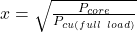
Transformer efficiency is maximum when:

Let the fraction of full load be x,

Hence,
⚙️ All-Day Efficiency (Distribution Transformer)
For transformers supplying load throughout the day, we use all-day efficiency:

It considers variable load over 24 hours (important for distribution systems).
🏭 Practical Example:
Distribution transformers near residential areas work 24 hours with varying load — so all-day efficiency is more meaningful than simple efficiency.
🧩 Real-World Analogy
Think of the transformer as a delivery person:
- Core loss = fuel wasted even when idle
- Copper loss = fuel wasted due to carrying load
- Maximum efficiency = when both wastes are equal
⚙️ Formulas (Plain LaTeX Only)




🔟 10 MCQs (GATE + ECET Mixed)
- In a transformer, core loss depends on:
A) Load current
B) Supply voltage and frequency
C) Load power factor
D) Both A and C - Copper losses in a transformer vary as:
A) Load
B) (Load)²
C) 1/Load
D) Constant - Hysteresis loss can be reduced by:
A) Increasing frequency
B) Using silicon steel
C) Using thicker laminations
D) Increasing flux density - Eddy current loss can be minimized by:
A) Laminating the core
B) Increasing flux
C) Reducing voltage
D) Using aluminum windings - Transformer efficiency is maximum when:
A) Copper loss = Core loss
B) Copper loss > Core loss
C) Copper loss < Core loss
D) Load = Full load - All-day efficiency is used for:
A) Power transformers
B) Instrument transformers
C) Distribution transformers
D) Auto-transformers - Which loss in a transformer is constant?
A) Copper loss
B) Core loss
C) Stray loss
D) None - For a transformer with iron loss 400 W and full-load copper loss 900 W, at what load will efficiency be maximum?
A) 25%
B) 50%
C) 66.7%
D) 100% - Which factor does not affect eddy current loss?
A) Thickness of laminations
B) Frequency
C) Load current
D) Magnetic flux density - A 100 kVA transformer has 1 kW iron loss and 1.5 kW copper loss at full load. Find efficiency at full load, unity power factor.
A) 98.5%
B) 97.6%
C) 98%
D) 96.8%
✅ Answer Key
Q.No Answer
1 B
2 B
3 B
4 A
5 A
6 C
7 B
8 C
9 C
10 B
🧠 MCQ Explanations (Step-by-Step)
1️⃣ B: Core loss depends on voltage and frequency only (flux density changes with V/f).
2️⃣ B: Copper loss ∝ (Current)² → hence varies as (load)².
3️⃣ B: Silicon steel reduces hysteresis loss due to its narrow hysteresis loop.
4️⃣ A: Laminating the core increases resistance to eddy currents → reduces eddy loss.
5️⃣ A: Condition for max efficiency: copper loss = core loss.
6️⃣ C: Distribution transformers run 24 hours → all-day efficiency is important.
7️⃣ B: Core loss is independent of load → constant.
8️⃣ C: x = √(400/900) = √(4/9) = 2/3 = 0.667 → 66.7%.
9️⃣ C: Eddy current loss depends on flux density, frequency, and lamination thickness — not load current.
10️⃣ B:
Output = 100 kW
Loss = 1 + 1.5 = 2.5 kW
η = (100 / 102.5) × 100 = 97.56% ≈ 97.6%
🎯 Motivation / Why Practice Matters (ECET 2026 EEE)
Transformer losses and efficiency questions appear in every ECET because they test your understanding of core + copper behavior — the heart of power systems.
Mastering this concept improves not just your marks but your grip over machines and power flow.
Remember — every great engineer started by measuring efficiency of simple lab transformers before handling megawatt units in substations.
Stay consistent, revise daily, and turn your curiosity into skill. ⚡💪
📲 CTA
Join our ECET 2026 EEE WhatsApp Group for daily quizzes & study notes:
👉 https://chat.whatsapp.com/GniYuv3CYVDKjPWEN086X9

